 43
43

Some files in Oakhill case made public
RELATED: Cafaro request says indictment is flawed
 Photo
Photo
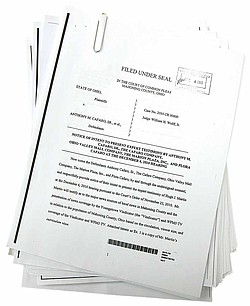
Hundreds of pages of documents in the Oakhill Renaissance Place criminal case were made public Tuesday, Dec. 7, 2010.
- Cafaro Court Case Documents - Uploaded 12/21/10
- Cafaro Court Case Documents
-
- #1 - Letter of John McCaffrey to Judge Wolff
- #2 - Letter of John McCaffrey to Judge Wolff (2)
- #3 - Request for Hearing
- #4 - Motion to address apparent violations
- #5 - 12/6/10 Schedule
- #6 - Motion for leave to file reply brief
- #7 - Brief in opposition
- #8 - Supplement to brief in repose
- #9 - Reply brief in support of joint motion
- #10 - Brief in response to joint motion
- #11 - Notice of furnishing of rule 16 discovery materials
- #12 - Order
- #13 - Motion in limine
- #14 - Motion to enlarge the pretrial motion filing deadline
- #15 - Motion in support of motion temporarily seal all bills
- #16 - Notice of intent to present expert testimony
- #17 - Brief in opposition
- #18 - Join reply of defendants
- #19 - Join motion of defendants
- #20 - State vs. Cafaro
- In more Oakhill coverage ...
-
- (5/17) COVERAGE: Top court removes paralegal deposition in Oakhill case
- (5/10) COVERAGE: Filing in Oakhill case accuses Gains of misconduct
- (4/23) COVERAGE: Debate goes on in Oakhill complaint
- (3/7) COVERAGE: Gains loses five issues before Ohio high court
- (3/1) COVERAGE: Judge: Oakhill lawyer won’t be on taxpayer dole
- (2/15) COVERAGE: Former JFS director wants lawyer at taxpayers’ expense
- (2/4) COVERAGE: County appoints outside prosecutor for high-court action in Oakhill case
- (2/2) COVERAGE: Oakhill judge denies latest plea for secrecy
- (1/25) COVERAGE: Vindy seeks high court help on Oakhill
- (1/8) COVERAGE: Defendants in Oakhill case seek more secrecy
- (1/4) COVERAGE: Prosecutors file last bill in Oakhill case
- (12/23) COVERAGE: Oakhill file points to FBI role
- (12/10) OPINION: Oakhill case opens this week — at last
- (7/29) BIOGRAPHIES: CAFAROS || Biographies
- (7/29) BIOGRAPHIES: OAKHILL PROBE || Other bios
- (7/30) OPINION: A break with public trust is ample cause for resignation
- (7/30) CHARGES: OAKHILL || WHO'S CHARGED
By DAVID SKOLNICK
skolnick@vindy.com
YOUNGSTOWN
Hundreds of pages of documents in the Oak-hill Renaissance Place criminal case under seal — ranging from appointing process servers to a lofty legal debate over the First and Sixth Amendments — were made public by the judge overseeing the matter.
William H. Wolff Jr., the visiting judge in the case, had the Mahoning County clerk of court’s office make the documents public Tuesday on the county’s website.
That decision came a day after Marion H. Little Jr., an attorney for The Vindicator and 21 WFMJ-TV, successfully argued there was no legal reason to keep several pretrial documents under seal.
The judge chose to have all nonroutine documents in the case filed under seal in mid-September, saying pretrial publicity could bias potential jurors.
Among the documents made public Tuesday are contentious filings in September to the judge from John F. McCaffrey, co-
counsel for some of the defendants, and from the case’s special prosecutors.
The documents were filed shortly before the judge’s
decision to have all of the nonroutine documents sealed so he could screen them before making all or parts of them public.
Although the documents by the attorneys were given to the judge in early September, they weren’t listed on the clerk’s website as existing till Tuesday.
McCaffrey wrote in a Sept. 2 filing that the prosecutors included a statement in a legal document that “contains gratuitous and inflammatory statements designed to incite the media and poison the public’s perception of the defendants.”
The prosecutor’s document was “more akin to a press release” and was an “effort to pander to the media,” McCaffrey wrote.
The prosecutors didn’t take too kindly to McCaffrey’s filing.
“‘Incredulous’ is the best word to describe our collective reaction and, frankly, [McCaffrey’s] letter was both insulting and disturbingly disingenuous,” they wrote in a Sept. 7 filing.
They added that they “ignored many of [McCaffrey’s] annoying transgressions” but spoke up when he decided to “send a repugnant, self-serving letter to a judge that makes unfounded accusations.”
McCaffrey and Martin G. Weinberg are co-counsels for Anthony M. Cafaro Sr., the Cafaro Co., and two of its subsidiaries, all indicted on charges of conspiring to criminally impede the move of the county’s Department of Job and Family Services from a building owned by the Cafaro Co. to Oakhill, purchased by the county in 2006.
The JFS moved to Oakhill, the former Forum Health Southside Medical Center, in 2007.
The others charged in the 73-count conspiracy indictment include county Commissioner John A. McNally IV; county Auditor Michael V. Sciortino; former county Treasurer John B. Reardon, and ex-county JFS director John Zachariah.
Also, two defendants — Flora Cafaro, part-owner of the Cafaro Co. and sister of Anthony Cafaro, and attorney Martin Yavorcik — are charged with one count each of money laundering and not with conspiracy.
In a filing about the criminal charge against Flora Cafaro, prosecutors wrote: “This is not the first time Anthony Cafaro or other members of the Enterprise has made clandestine payments and the state will seek to offer and introduce other acts evidence.”
McCaffrey wrote that the statement “foreshadows [the prosecutors’] intention to attack” Cafaro’s “character.”
McCaffrey contended that if similar accusations were made public, his clients could lose their rights to a fair trial, guaranteed in the Sixth Amendment of the U.S. Constitution.
In response, the prosecutors wrote: “We do not control what the media chooses to publish.” They also wrote that court filings in the clerk of court’s office are public records.
The prosecutors also wrote that they didn’t object when McCaffrey included “irrelevant documents which looked to us like a transparent effort at attracting media attention to your characterization of the case as one lacking evidence and providing your media spin to a defense that the move to Oakhill was somehow a bad thing.”
At Monday’s hearing, Cafaro’s attorneys argued that some records shouldn’t be made public because The Vindicator’s decision to publish the information could make it difficult to find an unbiased jury.
In a Nov. 10 filing and made public Tuesday, the attorneys for the two Cafaros and the three family-owned companies wrote that The Vindicator has a “well-documented institutional bias” against their clients.
The Cafaro filing claims the newspaper’s use of “the repeated moniker ‘The Oakhill 7’ [a not-so-subtle reminder of the infamous ‘Chicago Seven’ trial of the 1960s] undermines the presumption of innocence, particularly with its ‘mug shot’ type lineup of photos of the seven individual defendants.”
Judge Wolff decided after Monday’s hearing to make about 25 documents public that were under seal going as far back as the two letters, which predate his Sept. 9 and 14 rulings on documents in the case kept under seal.
Judge Wolff said Monday that a decision will be made shortly on whether to make public bills of particulars, documents that detail specific illegal acts prosecutors claim were committed by the accused, that were filed under seal for three of the defendants.
Those three are Zachariah, Reardon and Sciortino. The prosecutors made public the bills of particulars for Flora Cafaro and Yavorcik before the judge’s Sept. 9 and 14 orders.
The bills of particulars for Anthony Cafaro, the three companies and McNally haven’t been filed yet.