 43
43

Cafaro request says indictment is flawed
 Photo
Photo
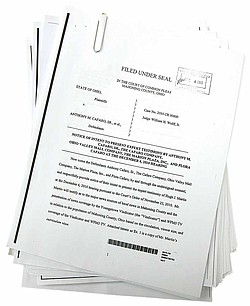
Hundreds of pages of documents in the Oakhill Renaissance Place criminal case were made public Tuesday, Dec. 7, 2010.
See also:
Some files in Oakhill case made public
- Cafaro Court Case Documents - Uploaded 12/21/10
- Cafaro Court Case Documents
-
- #1 - Letter of John McCaffrey to Judge Wolff
- #2 - Letter of John McCaffrey to Judge Wolff (2)
- #3 - Request for Hearing
- #4 - Motion to address apparent violations
- #5 - 12/6/10 Schedule
- #6 - Motion for leave to file reply brief
- #7 - Brief in opposition
- #8 - Supplement to brief in repose
- #9 - Reply brief in support of joint motion
- #10 - Brief in response to joint motion
- #11 - Notice of furnishing of rule 16 discovery materials
- #12 - Order
- #13 - Motion in limine
- #14 - Motion to enlarge the pretrial motion filing deadline
- #15 - Motion in support of motion temporarily seal all bills
- #16 - Notice of intent to present expert testimony
- #17 - Brief in opposition
- #18 - Join reply of defendants
- #19 - Join motion of defendants
- #20 - State vs. Cafaro
- In more Oakhill coverage ...
-
- (5/17) COVERAGE: Top court removes paralegal deposition in Oakhill case
- (5/10) COVERAGE: Filing in Oakhill case accuses Gains of misconduct
- (4/23) COVERAGE: Debate goes on in Oakhill complaint
- (3/7) COVERAGE: Gains loses five issues before Ohio high court
- (3/1) COVERAGE: Judge: Oakhill lawyer won’t be on taxpayer dole
- (2/15) COVERAGE: Former JFS director wants lawyer at taxpayers’ expense
- (2/4) COVERAGE: County appoints outside prosecutor for high-court action in Oakhill case
- (2/2) COVERAGE: Oakhill judge denies latest plea for secrecy
- (1/25) COVERAGE: Vindy seeks high court help on Oakhill
- (1/8) COVERAGE: Defendants in Oakhill case seek more secrecy
- (1/4) COVERAGE: Prosecutors file last bill in Oakhill case
- (12/23) COVERAGE: Oakhill file points to FBI role
- (12/10) OPINION: Oakhill case opens this week — at last
- (7/29) BIOGRAPHIES: CAFAROS || Biographies
- (7/29) BIOGRAPHIES: OAKHILL PROBE || Other bios
- (7/30) OPINION: A break with public trust is ample cause for resignation
- (7/30) CHARGES: OAKHILL || WHO'S CHARGED
YOUNGSTOWN
The Cafaro interests’ request to dismiss the Oakhill Renaissance Place criminal-conspiracy indictment says the document is fatally flawed due to its vagueness and that no bills of particulars can remedy that defect.
The special prosecutors replied, however, that their indictment meets well- established legal requirements and that more specifics pertaining to the charges will be provided in the bills of particulars concerning the Cafaro defendants that they are preparing for filing.
These arguments are contained in documents that were unsealed Tuesday by visiting Judge William H. Wolff Jr., after a Monday hearing on the request by The Vindicator and 21 WFMJ-TV to unseal pretrial documents in the case.
Monday’s hearing covered the document-sealing issue, but it did not address the Cafaro motion to dismiss the indictment.
Besides the documents unsealed Tuesday, the newspaper and TV station have sought unsealing of all bills of particulars, but bills of particulars that have been filed under seal by the special prosecutors concerning three defendants remained sealed Tuesday.
The defendants whose bills are filed but still sealed are Mahoning County Auditor Michael V. Sciortino, former county Treasurer John B. Reardon and John Zachariah, former county Job and Family Services director.
In the 73-count Oakhill indictment, five people and three companies are charged with conspiring criminally to impede the move of the county’s Department of Job and Family Services from Cafaro Co.-owned rented quarters to Oakhill.
Oakhill is the former Forum Health Southside Medical Center, which the county bought in 2006. JFS moved there in 2007.
Facing conspiracy and other charges are Anthony M. Cafaro Sr., former president of the Cafaro Co.; the Cafaro Co. and its affiliates, the Ohio Valley Mall Co. and the Marion Plaza Inc.; county Commissioner John A. McNally IV; and Sciortino, Reardon and Zachariah.
Two defendants, Flora Cafaro, part-owner of the Cafaro Co. and sister of Anthony Cafaro, and Atty. Martin Yavorcik are charged only with one count of money laundering and not with conspiracy.
The money-laundering charge pertains to an alleged concealed $15,000 gift from Flora Cafaro to Yavorcik’s unsuccessful 2008 campaign for county prosecutor. The special prosecutors publicly filed the bill of particulars concerning Yavorcik and Flora Cafaro before Judge Wolff ordered documents to be sealed.
To avoid pretrial publicity he said might bias potential jurors, Judge Wolff, in September, ordered that all nonroutine documents in the case be filed under seal to enable him to screen them before making all or parts of them public. The trial is set for June 6.
The Cafaro motion unsealed Tuesday says Judge Wolff should dismiss the indictment because it doesn’t give the defendants “constitutionally adequate notice of the charges against them,” “fails to include a plain, concise and definite written statement of the essential facts constituting the offenses charged,” and isn’t specific enough to ensure that the defendants won’t be unconstitutionally prosecuted twice for the same alleged offenses.
The perjury counts don’t define the offense, identify the proceeding in which the defendants allegedly lied under oath, or identify the allegedly false statements, according to a memorandum of law in support of dismissing the indictment.
The bribery counts span broad time periods, ranging from three years and three months to four years and 10 months, and they don’t identify the dates of the alleged payments or the valuable thing or benefit conveyed, the Cafaro interests said.
“The necessity of precision is heightened here given the First Amendment rights to petition, and even to seek to influence, government officials,” the Cafaro lawyers argued.
The money-laundering counts don’t make the required identification of the illegal activity from which the money was derived, the Cafaro interests’ lawyers argued.
In their response, the special prosecutors said the indictment adequately informs the defendants of the charges against them.
Under Ohio law, “an indictment is sufficient if it contains, in substance, a statement that the accused has committed some public offense therein specified,” the special prosecutors said.
“The Ohio Supreme Court has long recognized that dates and times are not essential elements of the offense unless a statute specifically requires date or time to be proved,” they added.
“The indictment is constitutionally sufficient to allege an offense against the peace and dignity of the State of Ohio.
“Ohio law is clear that the grand jury need not allege on the face of the indictment the alleged perjurious statement or the objective truth, and need not identify the proceeding or authority before which the statement was made,” the special prosecutors said.
“Each count of the indictment with regard to each of the defendants is legally sufficient to charge an individual defendant with the crime therein. Therefore the defendants’ joint motion to dismiss the indictment should be denied,” they argued.
Having delivered at least 56,000 pages of evidence to the defendants in the process known as discovery, the prosecutors said they are preparing the remaining bills of particulars “with all deliberate speed.”