 43
43

Valley survivors of Pearl Harbor recall ‘day of infamy’
The Vindicator (Youngstown)
 Photo
Photo
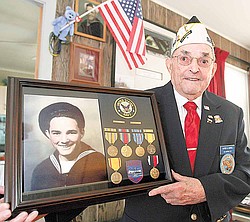
Alfred “Al” Gaskell of Howland, a member of the Pearl Harbor Survivors Association Mahoning Chapter 5, holds a display of the decorations he received from his service in the Navy in World War II. Included is a picture of himself in his Navy uniform from 1941.
See also:
PEARL HARBOR REMEMBERED
Alfred “Al” Gaskell was dressed in his “whites,” ready to go on liberty when the Japanese attacked Pearl Harbor on Dec. 7, 1941.
“At first we thought it was water bombs used for bombing practice hitting the water. We sat there for awhile, and then battle stations was announced,” said Gaskell of Howland, who was a deck hand on the USS Curtiss.
“We were lined up for breakfast when we heard explosions. We were not too concerned because the Army Air Corps had been conducting drills,” said Earl Husman Sr. of Braceville.
“All of a sudden, the blasts came closer and we saw some of our ships being bombed ... the USS Arizona took a bomb and blew up. That’s when we knew we were under attack,” he said.
James A. Werner was on special assignment painting the officers ballroom at the Army’s Fort Shafter on Oahu just outside Honolulu when the attack began.
“We thought it was practice. Then I looked up and saw the [red circle in the Japanese flag] on the planes and knew it was no drill.”
“I ran back to my outfit, but it had already pulled out. A friend and I broke the lock on the supply room and I got a [Browning Automatic Rifle] and a bunch of clips. I fired at the Japanese planes as they came over, but I didn’t bring any of them down,” he said.
Gaskill, Husman and Werner recalled their eyewitness accounts of the Japanese surprise attack on Pearl Harbor. The veterans, all of Trumbull County, are members of Pearl Harbor Survivors Association, Mahoning Valley Chapter 5.
Although the attack was 69 years ago, Husman, 90, said it remains vivid in his mind. But he said, “I don’t discuss it frequently.”
Gaskell is 87 and Werner, 89.
The attack came in two waves, one beginning at 7:53 a.m. and the second at 8:55 a.m. By 9:55 a.m. it was over, leaving 2,403 American military personnel dead and many more wounded, nearly 200 destroyed U.S. planes and a crippled U.S. Pacific Fleet.
Gaskell said a bomb and a Kamikaze suicide pilot crashed his plane into the Curtiss, a seaplane tender, killing and injuring “quite a few” crew members.
“We saw the USS Utah roll over and, even though we were on the other side of the island from where the USS Arizona was, we saw the Arizona blow up,” Gaskell said.
“I feel lucky to have survived. I didn’t get hurt, but very few of us were that lucky,” he said.
“A lot of the ships didn’t have any ammunition. I know we didn’t. Only the battle wagons (battle ships) were loaded for bear all the time. Support ships were not that heavily armed, but after Pearl Harbor, support ship armament was beefed up,” Gaskell said.
Gaskell said he has always wanted to return to revisit Pearl Harbor but never had the money. Now, he says he is not going back. “I couldn’t in good faith go aboard the Arizona. I just couldn’t handle Japanese [tourists] being there,” he said.
Pearl Harbor was not the end of the war for Gaskell, who later served at numerous places in the South Pacific.
After joining the Navy in November 1939, Husman took a course in hospital care and shortly after was transferred to the Naval Air Station on Oahu and then to Mobile Unit No. 4 on the edge of Pearl Harbor.
“We pulled many men from the water who were badly burned by oil burning on the surface,” Husman said.
After Pearl Harbor, he stayed in the Navy and retired after 20 years of active and reserve duty with the rank of chief petty officer.
Husman returned to Pearl Harbor for the 50th anniversary of the attack.
“It was interesting, and it was emotional. When we went out to the Pearl Harbor USS Arizona Memorial Visitor Center, most of the people there were speaking Japanese. It kind of got to me, but then I realized that it was several generations after the attack, and I couldn’t blame those people,” Husman said.
Werner said he had wanted to go to the Philippines when he enlisted in the Army. But there was one more opening for Hawaii, so he went there.
After Pearl Harbor, he transferred to the Army Air Corps and was sent back to the states for pilot training. But by that time the Air Corps had enough pilot candidates and Husman was sent to radio school and then back overseas, where he served on a “whole string of islands” in the South Pacific.
Werner went back to Pearl Harbor for the 50th anniversary but said he was disappointed.
“Honolulu was not what it had been. It got commercialized, with super highways all over the place. There were more Japanese tourists there than anyone else,” he said.