 43
43

Continental found guilty in Concorde crash
ASSOCIATED PRESS
 Photo
Photo
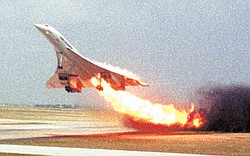
Air France Concorde flight 4590 takes off with fire trailing from its engine on the left wing from Charles de Gaulle airport in Paris, in this July 25, 2000 file photo. The plane crashed shortly after take-off, killing all the 109 people aboard and four others on the ground. A decade after a supersonic Concorde jet crashed in a fiery wreck outside Paris soon after takeoff, killing 113 people, a French court will rule at last Monday Dec 6 2010 on who, if anyone, is to blame.
Associated Press
PONTOISE, France
Continental Airlines and one of its mechanics were convicted of manslaughter Monday by a French court, which ruled that debris from a Continental plane caused the crash of an Air France Concorde jet that killed 113 people a decade ago.
The panel of judges fined Continental $268,000 and John Taylor, its mechanic living in the United States, $2,650. Taylor also was given a 15-month suspended prison sentence. Both said they will appeal.
Continental Airlines Inc.’s lawyer, Olivier Metzner, criticized the Pontoise court outside Paris for what he called a “patriotic” decision — blaming an American company while acquitting French officials accused of ignoring design flaws in the elegant Concorde, a jet that could fly at twice the speed of sound and was the pride of European aviation.
All other defendants in the case — including three former French officials and Taylor’s now-retired supervisor Stanley Ford — were acquitted.
The judges also ordered nearly $2.7 million to be paid in damages to Air France, families of some victims and other civil parties in the case. Air France, which wasn’t accused of any wrongdoing, will receive $1.43 million of those damages for the negative effect the case has had on its reputation.
Continental was ordered to pay the bulk of the damages, with a fraction of the burden falling to Airbus parent company EADS.
The presiding judge confirmed investigators’ long-held belief that titanium debris dropped by a Continental DC-10 onto the runway at Charles de Gaulle Airport before the supersonic jet took off July 25, 2000, was to blame.
Investigators said the debris gashed the Concorde’s tire, propelling bits of rubber into the fuel tanks and sparking a fire.
The plane then slammed into a nearby hotel, killing all 109 people aboard and four others on the ground. Most of the victims were Germans heading to a cruise in the Caribbean.
The crash marked the beginning of the end for the Concorde, which was a commercial dud despite its glamour, and which was retired in 2003 by its only two carriers, Air France and British Airways.
Ronald Schmid, a lawyer who has represented several families of the German victims, said he was “skeptical” about the ruling.
“It bothers me that none of those responsible for Air France were sitting in the docks,” he told The Associated Press by phone from Frankfurt.
Though France’s aviation authority concluded the crash could not have been foreseen, judicial investigators said the Concorde’s fuel tanks lacked sufficient protection from shock and said officials had known about the problem for more than 20 years.
The court ruled, however, that though French officials had missed opportunities to improve the Concorde over the years, they could “be accused of no serious misconduct.”
The court said Taylor — a Danish citizen with permanent U.S. residence — should not have used titanium, a harder metal than usual, to build a piece for the DC-10 that is known as a wear strip.
He was accused of improperly installing the wear strip, which fell onto the runway.