 43
43

French court to rule on Concorde crash of ’00
ASSOCIATED PRESS
 Photo
Photo
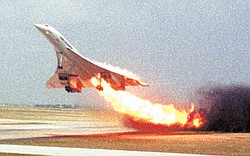
Air France Concorde flight 4590 takes off with fire trailing from its engine on the left wing from Charles de Gaulle airport in Paris, in this July 25, 2000 file photo. The plane crashed shortly after take-off, killing all the 109 people aboard and four others on the ground. A decade after a supersonic Concorde jet crashed in a fiery wreck outside Paris soon after takeoff, killing 113 people, a French court will rule at last Monday Dec 6 2010 on who, if anyone, is to blame.
Associated Press
PARIS
A decade after a supersonic Concorde jet crashed in a fiery wreck outside Paris soon after takeoff, killing 113 people, a French court will rule today on who, if anyone, is to blame.
The trial that started in February in Pontoise, northwest of Paris, reopened old questions over whether European engineers — or an American company, Continental Airlines — was responsible for the July 2000 crash of the European jet that symbolized elegance in trans-Atlantic air travel.
The verdict was expected this morning.
In the years it took French judicial investigators to work their way to trial, amassing 80,000 pages of court documents, the Concordes were revamped, retired and finally sent to museums.
But victims’ families will be watching the verdict closely, along with aviation experts.
Some in the industry fear the high-profile trial will discourage aviation officials from freely sharing safety information, fearing what they disclose might one day be used to prosecute them.
French judicial and aviation investigators concluded long ago that a Continental Airlines DC-10 dropped titanium debris onto the runway at Charles de Gaulle Airport before the Air France Concorde took off — a metal strip that gashed the supersonic jet’s tire and sent rubber pieces flying into the fuel tanks, causing a fire.
Continental contested that chain of events in court, calling up witnesses who testified the fire broke out before the plane reached the runway debris.
Continental lawyer Olivier Metzner argued that the U.S. airline was merely a convenient scapegoat.
Houston-based Continental Airlines Inc. and two of its U.S. employees are on trial for manslaughter.