 43
43

Hanukkah history is rich in tradition
The Vindicator (Youngstown)
 Photo
Photo
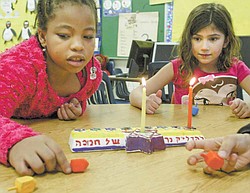
Sapphire Cathey, left, and Millie Heschmeyer, first-graders at Akiva Academy in Youngstown, spin dreidels, the Yiddish word for tops. Dreidels are part of the fun at Hanukkah, which began at sundown Wednesday. The eight-day festival continues until sundown next Thursday.
The Vindicator (Youngstown)
Photo
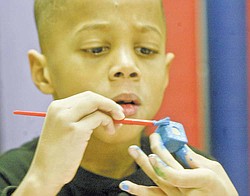
Bronx Teague, a first-grader at Akiva Academy, concentrates on painting a candle holder for a menorah. The students were learning about Hanukkah traditions, which include lighting candles on a menorah.
HANUKKAH CELEBRATION
What: The Jewish community and Akiva Academy will celebrate Hanukkah, which began at sundown Wednesday and concludes at sundown next Thursday, with a joint celebration.
When: 6:30 p.m. Tuesday.
Where: Jewish Community Center, 505 Gypsy Lane, Youngstown.
Details: A 10-foot menorah, the largest in the Mahoning Valley, will be on display throughout the eight-day festival of lights. The menorah previously had been displayed at Eastwood Mall in Niles and sponsored by Children of Israel Synagogue and Jewish Community Relations Council of the Youngstown Area Jewish Federation. The program will feature musical and dramatic presentations by Akiva Academy students. Refreshments will include potato latkes, jelly donuts and gelt (chocolate coins).
Information: The event is free and open to the public. For information, call the JCRC at 330-746-3250, ext. 183, or Akiva Academy at 330-747-0452.
By LINDA M. LINONIS
YOUNGSTOWN
The Jewish celebration of Hanukkah focuses on religious freedom, family, food and fun.
The eight-day festival of lights began at sundown Wednesday and continues to sunset next Thursday.
Susan Schonberger, Judaic studies and financial coordinator at Akiva Academy on Gypsy Lane, explained the history behind the observance.
Children at Akiva are learning about Hanukkah traditions and will present a program Tuesday at a community and Akiva joint celebration. The Akiva choir also will perform.
She said Hanukkah can be traced to the time of Alexander the Great, who conquered Persia. At the time, Jerusalem was part of the empire.
“At first, there was a positive interaction with introduction of sports and music under Alexander,” Schonberger said. But the Assyrian Greeks feared there was too much assimilation.
“Alexander, who believed in multiple gods, was openminded,” Schonberger said. “To him, the Jewish God was another god.”
The problem began in the small town of Modin, Israel, she said, when a Jewish priest refused to participate in a pagan sacrifice. The rebellion began, and the Hasmonean dynasty, nicknamed the Maccabees, led the revolution, Schonberger said. “They were of royal blood and had a priestly connection.”
The small group of rebels, known as freedom fighters, she said, defeated the larger-in-number and better-equipped Assyrian Greeks. When the Maccabees went to clean out the temple, they found only a small amount of oil for the eternal light. They lit it and went to get more kosher oil, Schonberger explained, and that took eight days.
“But, miraculously, the oil burned all that time,” she said.
The Maccabees fought for and won religious freedom, she said, and Hanukkah celebrates this.
The first candle on the menorah was lit Wednesday night, she explained, and allowed to burn down. Today, two candles will be lit, and so on throughout the observance.
“The helper candle lights the others,” she said, noting that in all, 44 candles are burned.
“Hanukkah is mostly a home-based ceremony,” Schonberger said. Jewish families are supposed to burn the menorah so it’s seen.
“It’s to publicize the miracle of the oil and how a small band overcame an army,” she added.
The dreidel, a Yiddish word for top, is used to play games. The four-sided top features a Hebrew letter on each side representing the Hebrew phrase “Nes Gadol Haya Sham,” which means “a great miracle happened there.”
Fried foods such as latkes (potato pancakes) and jelly doughnuts are served. “The connection is the oil,” Schonberger said.
Modern traditions include gift-giving, she said, and that is called gelt (gift), gold-wrapped chocolate coins and cookies.