 43
43

Walk focuses on plight of homeless
The Vindicator (Youngstown)
 Photo
Photo
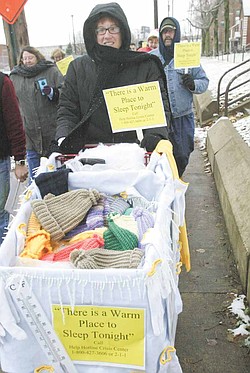
Participants in the third annual Homeless Walk make their way along Martin Luther King Jr. Boulevard in Youngstown. Cindy Pickens from Help Hotline Crisis Center pushed a shopping cart filled with knitted mittens and hats.
An estimated 1,400 people were homeless in Youngstown and Mahoning County in 2009, including 387 children, 29 percent of whom were under age 6. Here are more 2009 homeless statistics.
25 percent were age 51 or older.
534 people were members of a family.
58 percent were female; 49 percent were white; 49 percent were black; 11 percent were veterans.
20 percent were domestic-violence victims.
17 percent were chronically homeless. A chronically homeless person is an unaccompanied, disabled individual who has been continuously homeless for more than one year or experienced three episodes of being homeless within the last four years.
COLD WEATHER WORRIES
The homeless are at risk for frostbite and hypothermia, which can quickly become life- or limb-threatening.
Frostbite is the freezing of a specific body part, usually fingers, toes, the nose or earlobes. Signs of frostbite include lack of feeling in the affected areas and skin that appears waxy, is cold to the touch or is discolored (flushed, white or gray, yellow or blue).
Hypothermia is caused by cooling of the body because of failure of the body’s warming system. Signs of hypothermia include shivering, numbness, glassy stare, apathy, weakness and impaired judgment.
Source: Youngstown/Mahoning County Homeless Management Information System; St. Elizabeth Health Center Level 1 Trauma Center.
By William K. ALCORN
YOUNGSTOWN
There is no good time to be homeless.
But Wednesday morning’s dusting of snow and temperatures near freezing were harbingers of winter, the worst time in Northeast Ohio to be without a safe, dry, warm place to stay, say those who advocate for the homeless.
To raise public awareness of the plight of the homeless and kick off the 2010-11 Cold Weather Emergency Shelter Program, some 30 agency officials and residents bundled up to participate in the third annual Homeless Walk.
The walk began at 9 a.m. at the Rescue Mission of Mahoning Valley on Martin Luther King Jr. Boulevard and ended about 30 minutes later with a press conference at the St. Vincent de Paul soup kitchen at 208 W. Front St.
“I especially appreciate the Rescue Mission,” said Terry Vicars of Catholic Charities’ COACH (Case Management Outreach and Advocacy for the Community Homeless) Program.
“It is clean as can be, very secure and has a great staff. It’s scary to become homeless, and the Rescue Mission is a welcoming place,” he said.
Earl Sr. and Christine Boylen, residents with their teenage children at the Rescue Mission, agree.
The Boylens moved back to the Ashtabula area from Florida in March to find better educational opportunities for a daughter with special needs but could not find a home to rent. They lived in a motel for five weeks, and when they ran out of money, they stayed with friends until August, when they called 211 for help.
They were referred to Catholic Charities in Ashtabula, which put them in touch with the Rescue Mission.
“We don’t know what we would have done if the mission was not here,” Mrs. Boylen said.
Earl is trying to get his commercial driver’s license renewed so he can get work driving trucks, and Christine, who has been a homemaker up to this point, wants to get some type of vocational training.
“Our top priority is to find a permanent place to live,” Earl said.
A primary purpose of the homeless walk is to raise awareness about the services available to homeless people, said Duane Piccirilli, Help Hotline executive director.
Among services available are Vicar’s COACH program, which gives him at least one day a week to do outreach to the homeless by frequenting soup kitchens, walking the streets, checking vacant buildings where the homeless might be living, trying to find people who aren’t accessing the services available to them.
He also administers a federal Rapid Rehousing Grant that can provide the security deposit and the first-month’s rent to assist the homeless to get into housing.
Community Legal Aid’s HALO (Homeless Advocacy: Law and Outreach) program is another service for the homeless. It can help expunge criminal records so they can get jobs and community housing, It also assists with welfare, Social Security and landlord-tenant issues, said the program’s James Ford.
Turning Point Counseling Services, a behavioral health center serving adults, has two inpatient beds in its Crisis Stabilization Unit for homeless adults with severe mental illness, said Pam Price, CSU coordinator and president of the Mahoning County Homeless Continuum of Care Board.
The Continuum of Care is a coalition of community agencies that help the county’s homeless and near-homeless obtain housing, economic stability and an enhanced quality of life through comprehensive services, she said.
In Mahoning County, there are homeless individuals and/or families who often sleep in vehicles, abandoned buildings, doorways or anywhere to get out of the cold and inclement weather, said Bob Altman, coordinator the Cold Weather Emergency Shelter Program.
“Our primary goal is to make sure no one freezes to death because they do not have a warm place to sleep,” he said.