 43
43

Proven mettle
By WILLIAM K. ALCORN
alcorn@vindy.com
POLAND
 Photo
Photo
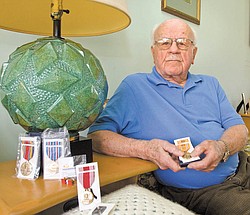
Nick Leonelli, 87, of Poland shows medals he earned serving in the Army in the Pacifi c Theater during World War II but did not receive until recently.
 Photo
Photo
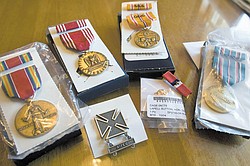
Leonelli’s medals include the Asiatic-Pacifi c Campaign Medal with three Bronze Battle Stars, signifying his participation in the Battle of New Guinea and the Battles of Layte and Luzon in the Philippines.
Nick J. Leonelli didn’t worry much about not receiving the medals he earned during his military service in the Pacific during World War II.
He said he had other priorities after the war: going to college, raising a family and earning a living.
But last year, Leonelli, of Poland, mentioned to a friend, who is a member of the Veterans of Foreign Wars, that he had never gotten his medals and learned, to his surprise, that he could still get them.
“I thought, why not? I worked for them, and they are mine and I deserve them,” the 87-year-old Army veteran said.
“I want my son and grandchildren and the rest of my family to know what went on then and about my part in it,” he added.
He has a son, Dr. James Leonelli, an obstetrician/gynecologist in Boardman; and four grandchildren, three in college and one in high school.
Leonelli, the son of Giustino and Carolina Leonelli, is a 1941 graduate of Youngstown East High School, where he was president of his senior class. When he was born, the family lived in the Smoky Hollow area, but a couple of years later, he moved to Oak Street near Lincoln School on the East Side.
During his working years, he was employed as a planner and engineer for the Edward J. DeBartolo Corp.; for Youngstown State University, where he was director of the physical plant; and before the war, in the mill at Republic Steel Corp. in Youngstown.
The year 1953 was huge for Leonelli. He graduated from YSU with a degree in mechanical engineering, went to work for the Debartolo Corp. and got married to the former Carmel Salpietra, who was a South High School graduate.
“Thank God for the G.I. Bill. Without it, I would never have gone to college,” he said.
He said Edward J. DeBartolo Sr., his cousin and owner of the Debartolo Corp., not only provided him with a good job he also was responsible, in a way, for his marriage.
Carmel and Debartolo’s wife, Marie, were good friends, and the Debartolos “set us up.”
“I didn’t want to date her at first, but I’m glad now. She was the best wife a man could ever have,” Leonelli said.
Leonelli started the process to get his medals in August 2009. In November of the same year, he was notified by the Military Personnel Records Center of the decorations to which he was entitled.
Topping the list is the Asiatic-Pacific Campaign Medal with three Bronze Battle Stars, signifying Leonelli’s participation in the Battle of New Guinea, and the Battles of Layte and Luzon in the Philippine Islands.
His other decorations are World War II Victory Medal; American Campaign Medal; Philippine Liberation Ribbon, which he would not receive because the Philippine government no longer provides them; Honorable Service Lapel Button; Marksmanship Badge with Rifle Bar; and the Good Conduct Medal.
A cryptographer, Leonelli, drafted into the Army in April 1943 at 21, was stationed on Luzon in the Philippines toward the end of the war. He was in charge of the signal center, making him privy to a lot of messages.
“Our job was to break coded messages, translate them into another code and send them on their way,” he said.
“One morning at about 1 a.m., the machine got busy as hell. I was typing the translation of a message with the priority of secrecy and realized that a U.S. general had received word that one of Japan’s top generals, Tomouki Yamashita, wanted to surrender, and the U.S. general didn’t know what to do,” Leonelli said.
He passed the message on to headquarters, and about 4:30 a.m., a coded message came back on the teletype from Gen. Douglas McArthur detailing arrangements for the surrender in Baguio City, Luzon.
Leonelli’s sister had written him in summer 1945 that their mother was ill with cancer and said he needed to come home as soon as possible.
Leonelli, a member of the occupation force in the Philippines after the war, asked for a furlough but was told he was not eligible for leave because he was about to be discharged.
Eventually, his commanding officer arranged for him to fly to the United States from Manila. After stops in Guam and Hawaii, he landed in San Francisco and traveled by train to Camp Atterbury in Indiana, where his journey home again was stalled.
“I told the commander that my mother was sick and I wanted to get home to see her before she died. I told them I would go AWOL if they didn’t let me go, and finally they did,” Leonelli said.
He arrived in Youngstown at 7:30 a.m. Dec. 28, 1945, only to learn his mother had died the previous midnight.
Because he had been in a rush to get home, he asked the Army to mail him his discharge and medals. The discharge arrived, but the medals never did, he said.
But, to his delight, the medals arrived March 18 — 65 years late but much appreciated, he said.
“I saw the envelope and return address and said, ‘Oh my God. I don’t believe it,’” Leonelli said.
He said his wife, who died July 12, 1991, would have been proud.
“I’ve had a good life, despite the setbacks. I worked hard all the time,” he said.