 43
43

Juvenile officer returns to duty
 Photo
Photo
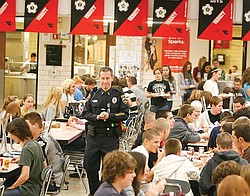
GETTING REACQUAINTED: Canfield Patrolman Paul Lasky walks through the cafeteria of Canfield High School and converses with students. Lasky returned to his place as the school resource officer for Canfield Local Schools on Monday after a two-month absence.
 Photo
Photo
SERVE AND PROTECT: Paul Lasky, juvenile officer with the Canfield Police Department, displays this badge at Canfield High School. Lasky has more than 30 years of experience in law enforcement and has been involved with Canfield schools since 2000.
By Jon Moffett
CANFIELD — Canfield High School students will see the familiar sight of a city police car parked outside the building.
Patrolman Paul Lasky, a trained juvenile officer, returned to his post as school resource officer Monday. School officials are excited and relieved to have a police presence back in the schools.
Lasky will oversee grades kindergarten through 12 and has an office in the high school.
“What happens at school can spill out into the community, and what happens in the community can spill over into the school,” Lasky said. “So being able to help out young people and gain valuable information about what is going on can certainly help out law enforcement.”
Lasky has 30 years of experience in law enforcement and has been the school resource officer since January 2000.
A grant originally paid for Lasky’s service in the school, but it ran out in 2003. The city had paid Lasky’s full salary until 2008, when the cost was split with the township. But the agreement was not renewed when the city and township did not agree on the financial terms, leaving the school without an officer for the first two months of the school year.
“The way I see it, from September until now, it was reactionary,” said Canfield Superintendent Dante Zambrini. “So if I or anyone else in the other buildings had a problem, we would call the police and be taken care of. But it was more reactive, whereas this is proactive.”
The city and township reached an agreement last month. The township will pay about $30,000 for the nine months the officer is in the school. Lasky’s full contract is worth about $80,000.
Lasky said the idea of a school resource officer stems from community policing.
“Back in the old days, you’d have an officer walking the beat in a big city,” he said. “What would happen is that officer would become very familiar with the people on his beat; they would know him, and he would know them.”
In addition to enforcing law, Lasky said one of his major responsibilities is to act as a liaison between the students and the school administration and represent an educational resource as well as a law-enforcement figure.
“It’s really important to establish a good rapport with the students and a sound foundation,” he said. “For so many people, the only contact they have with police is in a negative way. ... But it’s so important for these kids to be able to go up to an officer, for the officer to know their name and be able to discuss things freely and have the student ask about the law.”
Zambrini praised the police department and city and township officials for providing a police presence in the schools. He said the added security a police officer’s presence provides helps the school assess, handle and defuse problems before they become major issues.
Zambrini said, “I would much rather react to a growing problem rather than a problem that has already exploded.”
jmoffett@vindy.com