 43
43

Third-graders take over government for a day
 Photo
Photo
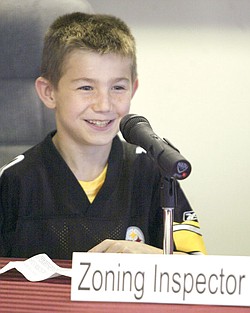
LEARNING THE RULES: John Popa, a South Range Elementary School third grader, became Beaver Township’s temporary zoning inspector as students assumed the roles of township officials during a mock trustees’ meeting Friday. The visit to the township administrative offices was an educational experience for the children.
 Photo
Photo
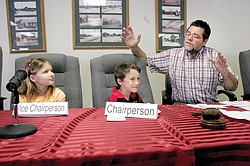
TEMPORARY TRUSTEES: Larry Wehr, a Beaver township trustee, explains the workings of township government to South Range third-graders Megan Kiselica and Cameron Tarr during a mock trustees’ meeting. The educational event took place Friday in the township administrative office.
The students listened to concerns ranging from fixing potholes to replacing culverts.
By Sean Barron
NORTH LIMA — Megan Kiselica wouldn’t mind running for president of the United States one day, but being a township trustee also fits into her political aspirations.
Becoming a future local trustee also fits Cameron Tarr to a T.
“I’d like to talk to a lot of important people. I can see myself in a gray suit and red tie,” Cameron said with a chuckle.
Well, Megan and Cameron got their wishes to be trustees — at least for one day, anyway.
The two South Range Elementary School third-graders, along with fellow “trustee” Neil Buzzacco, got to conduct a meeting Friday at the Beaver Township Administration Building, 11999 South Ave.
The school’s 108 third-graders have been studying local government and, as part of their school project, organized and named four townships. Then, each township (Genius, Sports, Raiders and Smarty) held its own session, which gave the youngsters a hands-on sense of how government works.
Cameron and Megan were part of Sports Township.
Throughout the past week, the kids ran for their elected positions. Many of those who weren’t selected as trustees or department heads were appointed to other spots; some acted as local residents with a variety of concerns and issues to be addressed.
“It’s easier with friends, but when grown up, a little harder,” Megan said, giving her assessment of the meeting and being a member of a government body.
Moderating the four sessions was Beaver Township Trustee Larry Wehr, who guided the youngsters through the process of conducting a typical meeting.
One each was elected to be fiscal officer, road superintendent, park board chairperson, police and fire chief, zoning inspector, chairperson and vice chairperson, recycling coordinator and emergency management services director.
The students were told, for example, that 150 flags needed to be replaced, then were asked to decide and make a motion on whether to buy cheap flags or ones at $50 each that would probably last longer. They opted for the latter, and the fiscal officer made a roll call before deducting $7,500 from an account.
When it came time for the department heads’ reports, one issue was whether to spend $33,000 for a new police cruiser or defer it until next year and take their chances with the current, older ones.
Wehr explained the advantages and potential pitfalls of each side (the students voted to wait on the purchase).
Also at issue was whether to change the zoning status on a South Avenue parcel from residential to industrial so that a factory could be built near a school. The third-graders had to consider that the plant would create new jobs, as well as potential problems from being located next to the school.
Other youngsters playing the part of residents came to the microphone and expressed reasons for their support or opposition before the vote was taken and the idea was rejected.
Several other students acting as homeowners took the floor and wanted to know how the elected officials would handle a myriad of issues such as filling potholes, cracking down on speeding motorists, plowing snow-covered roads, living next door to a neglected home and fixing a faulty culvert.
The youngsters also considered a recreational equipment levy, which would raise $1 per pupil for playground equipment at their school to be used starting next school year.
Wehr explained some advanced concepts, such as how the county and township can have jurisdiction over separate portions of the same road, but gave the elected youngsters plenty of opportunities to come up with solutions to the challenges they faced.
Wehr noted that the concerns and issues the students dealt with reflected what goes on in the township and at a typical session.
The project was valuable for the children largely because it took the roles of government from the abstract to the “real life,” noted Tawny Templin, a third-grade teacher. The students were “excited beyond belief” when Wehr came to their school, she said.
“Having the children experience [the role of government] firsthand sticks with them more,” Templin added. “They’ve internalized it.”