 43
43

Warren ponders value of operating Packard Music Hall
 Photo
Photo
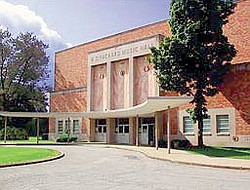
FATE UNCERTAIN: Will the city of Warren continue funding the historic W.D. Packard Hall on Mahoning Avenue in light of the city’s sagging finances?
MUSIC HALL History
Built in 1955 with money donated by H.D. Packard at a cost of $1.5 million.
Conditions of the donation: As with Packard Park, the city was obligated to operate and maintain the music hall or the property would revert to the Packard family.
Source: Chris Stephenson, music hall manager
By Ed Runyan
The city spends about $300,000 a year to keep the Valley icon running.
WARREN — The city’s financial problems have caused some council members to consider reducing or eliminating funding for one of the city’s landmarks, Packard Music Hall.
The Mahoning Avenue Northwest facility has long been home to various types of entertainment, commencement ceremonies and was at one time home to the successful Kenley Players theatrical performances. The music hall was built in 1955 as a $1.5 million gift to the city from W.D. Packard.
But when the 42 acres known as Packard Park and the money to build the music hall were given to the city in the early part of the 20th century, they came with the condition that the city maintain them.
If at some point the city didn’t keep the land as a park or didn’t maintain the music hall, its ownership reverts to the Packard family, said Chris Stephenson, music hall manager.
Because of that agreement, members of city council met this week to discuss legislation proposed by Councilman Dan Crouse to eliminate $150,000 of the approximate $300,000 the city spends each year to keep the music hall running.
Crouse said the purpose of his legislation is to reduce the music hall’s dependence on the city’s dwindling revenue by finding ways to make it more self-sufficient.
He had hoped to get some legal advice from Greg Hicks, Warren’s law director, on whether long-standing restrictions on how the music hall operates could be changed, but Hicks was not available.
Crouse and Chris Stephenson, music hall manager, said the music hall has always had to operate as a rental facility only, not as a promoter of performances, because a city is not allowed to risk taxpayer money on shows that might lose money or might make money.
But by only having the opportunity to rent the hall to other groups, the music hall has trouble making enough money to be self-sufficient, Stephenson said.
The Packard Museum Foundation was formed about six years ago to conduct fundraising and allow the music hall to use the foundation’s money to stage performances. It has helped, but it hasn’t achieved self-sufficiency, Stephenson said.
“We need to decide whether we want to be in the music hall business,” Councilman Andy Barkley said this week. “If we are, there’s going to be some cost. If we’re not willing to accept the responsibility, we should get out of the music hall business.”
Councilman James “Doc” Pugh said it just might be time for the city to get out of the music hall business.
“I’d rather spend $60,000 on a cop on the street than entertainment,” Pugh said. City officials have said a firefighter costs around $90,000 per year, including the cost of benefits such as health care.
“We don’t have the customers to keep it open,” Pugh said. “We can’t expect people to spend $30 for a night of entertainment at Packard Music Hall,” Pugh said, adding that by the end of the year, things are likely to be worse.
Barkley said he thinks people do spend money on entertainment during tough economic times, using as an example the number of people who have attended shows at the former Chevrolet Centre (now Covelli Centre) in Youngstown in recent months.
“You don’t sell off your long-term assets to solve short-term problems,” Barkley added.
Councilman Al Novak said he is ready to propose legislation that cuts off all funding for the music hall effective Jan. 1, 2010, but only so that the public will take an interest in the matter and learn the implications of reducing or eliminating funding for the music hall.
“I’m sure this would cause more people to come out,” Novak said.
Stephenson said he doesn’t know what would happen to the music hall if funding were eliminated or reduced, but noted such a move would make it even more difficult for him to book the hall and lead to a downward spiral.
Warren residents surveyed Tuesday afternoon on the issue as they pulled into a downtown gas station mostly said they didn’t feel the music hall is important enough to pay $300,000 per year to keep, especially when police officers and firefighters are having to be laid off.
“You need police and firefighters,” said Angela MacMichael of Warren. “If you had to choose between the music hall and losing police officers, I would go with keeping police officers,” she said.
“I’ve been here since 1991, but I’ve never been there,” she said of the music hall.
Her daughter, Caitlin Rudy, 10, who went to the music hall for a performance, piped up without being asked, however.
“It’s nice. I like the music hall,” she said.
James May of Warren said he’s been a singer for 30 years and has been performing at churches all over the city. He sang once at the music hall, “but the turnout wasn’t that good,” he said. When asked whether he could live without the music hall, he said: “I am living without it.”
Malinda Owens of Warren said she believes police and fire are among examples of areas where the city needs the money more than the music hall.
runyan@vindy.com