 43
43

From Russia, with love: Hubbard couple adopt girl from crowded orphange
A year has passed since this family grew by two feet.
By JoAnn Jones
Vindicator Correspondent
Anastiya Costello
 Video
Video
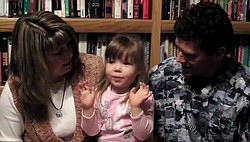
Sam and Katie Costello with their daughter Anastiya, 3, who was adopted from Russia.
HUBBARD — Three-year-old Anastiya Costello has red, blue, green and yellow bedroom walls decorated with Dr. Seuss characters and scenes, all painted by her parents and godparents.
Thus, it’s quite appropriate that one of the books on her bookshelf is “Oh, the Places You’ll Go,” one of Dr. Seuss’ most popular books.
And where did she go?
Anastiya left a crowded orphanage in Vladivostock, Russia, in April 2008 to go with her adoptive parents, Katie and Sam Costello, to her new home in Hubbard — a home filled with eight dogs, seven cats and a whole lot of love.
“This is something I’ve always wanted to do — adopt,” Katie Costello, a Hubbard native, said. “We got married in 2005, and by 2006 I was looking more and more at it [adoption] online.”
“But there was so much paperwork, it was unreal,” she said.
Working through the Rainbow Babies and Children’s Hospital Adoption Clinic, which employs four doctors just to evaluate children to be adopted, the Costellos were “matched up” with Anastiya (pronounced “uh NOST ee uh”) by January 2008. That month they traveled to Vladivostock, a port on the Pacific Ocean close to the Russian border with Korea, to meet her and spend four hours a day for a week with her at a hotel.
But then they had to leave her.
According to the adoption process and the mounds of accompanying paperwork, the Costellos had to leave Anastiya for eight weeks while everything passed through the Russian courts.
“We knew we had to leave her,” Katie said, “and we tried to prepare for that, so we planned things to keep us super busy in between, like doing her room.”
“It was horrible going over once and leaving her,” Sam said. “I thought I’d be much better at this because I’m a pretty patient guy.”
The orphanage
Anastiya had been taken from her 28-year-old unwed mother when she was 1. The Costellos could learn nothing about her father.
“It was very difficult to get the truth,” Katie said.
“It was the most unnerving thing. We went by the court documents.”
According to the Costellos, the children in the orphanage spent most of their time in cribs and had to share clothing. The only things they called their own were their shoes.
“Her Russian caregivers were all over 50,” Katie said, adding that the children ate borscht, an Eastern European vegetable soup usually made with beets, every day.
The Costellos had to stay in Vladivostock a month while they were waiting for their court date to seal the adoption. Paying a Russian woman to translate and file all the necessary paperwork, they also spent a small fortune with their month’s stay while neither of them was working.
“It was very, very expensive,” Katie said. “I don’t think we’d do it again, but if she had had a sibling, we would have brought two children back.”
She added that last July they, along with friends in Oklahoma who had adopted a child from the same orphanage, held a garage sale and raised $4300 to send to the children. They specified how they wanted it spent and sent the money with another family that was going to Vladivostock to adopt a child.
How she’s doing
Anastiya, who goes to preschool two days a week for socialization, appeared too grown-up when the Costellos first met her, Katie said.
“It was uncanny ... she would change and feed herself,” she said. “At age 21⁄2, she had to learn that her parents would take care of her.”
“While we were still in Russia, she was very interested in Sam and not in me,” she said. “They didn’t see many men. But now it changes frequently. One week I’m No. 1, and another, he is.”
“She greets me at the door in the evening,” Sam said, “and associates me with going outside. I’m outside a lot, and she likes to play and be tossed around.”
To aid her development, Anastiya also goes to speech therapy and to physical therapy.
“When we first brought her home, her feet were so far apart, she couldn’t run because she had spent the majority of her time in a crib,” Katie said.
“Her speech therapist is phenomenal,” she said, adding that her receptive language is progressing rapidly and she is speaking more.
“She’s made a huge jump developmentally,” Katie said. “Everything is coming together. Our goal is to get her caught up by kindergarten.”
To check her progress, the Costellos take her to Rainbow Babies and Children’s Hospital in Cleveland every six months, where the adoption doctors work with former institutionalized children.
Family life
Comfortable with the family’s menagerie, Anastiya toddles from room to room, stopping to pet a dog or cat here and there. Sam is one of four owners of the Town and Country Veterinary Clinic in Howland, while Katie works there part time.
“We were concerned about the animals,” Katie said. “Our biggest fear was how well it would work. But she was immediately fine and wanted to touch them.”
Four of the dogs participate in Canines for Compassion, a program Katie started in 2000 in which the dogs visit four hospitals and 22 nursing homes to cheer up patients.
Adapting to American food came easily for Anastiya. She loves fruits, especially strawberries, and salad as well as cherry tomatoes. The Costellos are vegetarians.
“It’s probably stuff she never got,” Sam said, adding that she sometimes eats a few bites of cake but that “leaves more for me.”
Outside the immediate family, Anastiya has cousins her age to play with and, of course, four doting grandparents, who met her immediately upon her arrival at the Pittsburgh International Airport last year.
But the family tries to keep any gathering small so she won’t be overwhelmed.
“Even her baptism April 19 at St. Patrick’s in Hubbard was small,” Katie said.
The Costellos plan to help her remember her Russian heritage with international dinners, Russian nesting dolls and recordings of Russian lullabies, which they bought when they went to Vladivostock.
“Every holiday, we’re going to buy something Russian to give her,” Katie said. “Probably when she becomes a teen, we’ll take her back to the village where she was born.”
“‘She’s a lucky girl’ is a comment we hear,” Katie said. “But we’re definitely the lucky ones.” And on this Mother’s Day, her second one, she certainly is.