 43
43

Valley man preps dogs for police work
 Photo
Photo
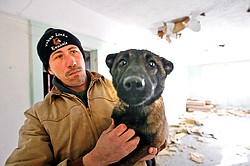
MAN'S BEST FRIEND: Dog trainer Dave Blosser gives Storm, an 11-month-old Belgian malinois, some personal attention. Storm is one of the dogs Blosser is training for police work.
K-9 Dog Training
 Video
Video
By Don Shilling
A former factory worker found his passion, which is training dogs.
For Storm, searching for a tennis ball is fun. Biting someone wearing a protective arm sleeve is a game.
But soon, the 11-month-old puppy will be doing his searching and biting as an officer of the law.
Storm is one of the Belgian malinoises being trained by Dave Blosser of Bazetta Township to be a police dog. After the dog is trained to track a person and find a bomb, drugs or a body, Storm will be sold for between $6,000 and $10,000.
Blosser operates Tri-State Canine Services, which trains up to 30 dogs a year for police work.
He has developed a substantial business. His dogs have been used locally at police departments such as Warren and New Castle, Pa., and nationally at departments in 13 states and with the Secret Service, Army and Navy.
A private contractor has bought Blosser’s dogs and sent them to Iraq to look for people killed in bomb blasts and to sniff vehicles entering nuclear power plants.
Blosser’s passion has made him a favorite with Warren police officers who have dogs.
“Dave lives and breathes dogs. He’s incredible,” said Sgt. Sherrey McMahon, whose partner is Arras.
Blosser provides periodic training to the Warren officers.
“Anytime. Anywhere. It doesn’t matter if it’s 3 in the morning, he will listen to you and give you advice,” McMahon said.
Blosser’s success with police dogs is unusual because he was a factory worker when he started, not a cop, said Ken Licklider, who owns a dog-training facility and kennel in Indiana.
“The police world is tough to break into when you are not a cop. But Dave was so motivated and so 100 percent into it that it was instantly OK,” Licklider said.
Blosser, 38, became a part-time Fowler Township police officer in 2007, but his involvement with dogs began in 1992.
He bought a Rottweiler and got involved in schutzhund, a sport that tests dogs’ ability to do police-type work. That connected him with area police officers who had dogs.
He volunteered to help with training, and that meant getting bitten — a lot.
He would wear a protective suit, play the role of a suspect and allow a dog to attack him.
“You just do it to do it. Some people play basketball. We like work dogs. That’s our hobby,” he said.
He gradually learned more about the dogs and what makes a dog want to find a drug or a bomb. Then he became a dog handler for the Northeast Ohio Search and Rescue, which searches for missing people, and learned more about outside search.
He also talked to local police officers about their dogs’ training and started to develop his own training methods.
In 2001, he formed his company, while still working as a welder.
His occupation became a running joke in dog-training circles once he started bringing dogs to competition. In 2002, one of his dogs placed 12th in drug detection at the Police Canine Olympics in Muncie, Ind., and the next year his dogs took a first and a third.
He later attended training at Licklider’s Vohne Liche Kennels. That experience helped him learn more about how to motivate a dog.
Licklider is impressed enough with Blosser’s work that he buys most of the dogs that the local man trains. Licklider and his trainers provide the dogs with additional instruction and then resell them to police departments and other agencies.
Blosser said he sometimes sells dogs directly to police departments, but he prefers acting as a wholesaler because he doesn’t have to spend time training officers on how to handle the dog.
He trains dogs to search for four different drug odors, 13 bomb odors and bodies. For that last odor, he has bought tissue from a university research center to use in training.
Training can start before a dog is a year old, but the timing depends on the dog, he said.
Basic search skills can be learned in about a month, but dogs need additional training to be able to search an entire building or hundreds of cars, he said.
Before training starts, however, Blosser works with young dogs to instill what’s called “the drive.”
Simply put, Blosser wants the dogs to really want to play with a toy, such as a ball. If the dog really likes a certain toy, that makes training easy. Plus, the toy serves as a nice reward for a behavior that’s accomplished correctly.
To begin search training, Blosser puts a ball in a wooden box with a hole that’s large enough for the dog to reach in and pull it out in his mouth. Then Blosser starts putting the ball in a box with a smaller hole that doesn’t allow the dog to reach all the way inside.
Inside this box, along with the ball, is the odor of a drug, bomb or dead body. As the dog sniffs for the ball, he begins to associate the odor with the ball.
As he sniffs, Blosser teaches the dog to sit by the box. When the dog sits, Blosser reaches through a hole in the side of the box and pushes the ball up to the dog.
Eventually the dog learns to sit when he smells the odor. And when he sits, he gets rewarded with the ball.
The key to the training — whether it’s finding an odor or latching onto a suspect — is to develop step-by-step training system that rewards dogs for certain behaviors, Blosser said.
shilling@vindy.com