 43
43

GM pins its hopes on the Volt
 Photo
Photo
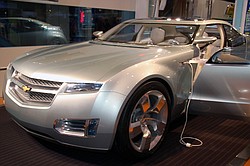
The 2008 Chevrolet Volt Concept at the Cleveland Auto Show.
 Photo
Photo
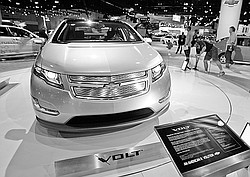
The Chevrolet Volt all-electric concept car is seen on display at the GM exhibit during media previews for the Los Angeles Auto Show Wednesday, Nov. 19, 2008. The show opens to the public Friday, Nov. 21.
Washington Post
WASHINGTON — General Motors frequently holds up the Chevrolet Volt as a symbol of its future and a testimony to its ingenuity when it asks Washington officials for billions of dollars in federal aid.
So prominent a role has the battery-powered car played in discussions that when members of President Obama’s auto task force flew to Detroit earlier this week for a series of meetings, they decided to take it for a spin.
Their impression, according to an administration official: The Volt certainly shows promise, but it is no panacea for what ails GM in the near term.
The problem is GM will likely have to price the vehicle far higher than a comparable family car with a gas-powered engine, putting it out of reach for many consumers, particularly if oil prices remain low.
Further, the rollout comes as rivals roll out partial-electric hybrids at a fraction of the cost.
With the ability to drive 40 miles on a single charge, the Volt aims to usher in a new era of gasoline-free daily commutes when the car debuts in late 2010 in the Washington area and San Francisco, GM officials say. But some analysts and government officials predict the car may be initially priced up to $40,000, and possibly more, because of its costly lithium-ion batteries.
“Over time the costs will come down and be competitive with conventional cars,” said Bob Lutz, GM vice chairman for global product development, who has taken on the Volt as his last project before retirement.
Meanwhile, hybrid fuel-efficient cars are getting cheaper as the competition for alternative-fuel vehicles heats up. Honda’s Insight LX, a traditional gas-electric hybrid that goes on sale this month, will start at $19,800. Chinese battery manufacturer BYD sells a plug-in for $22,000 and plans to enter the U.S. market in 2011.
Toyota plans to start testing a plug-in, lithium-ion version of its Prius at the end of this year. Chrysler has created several plug-in electric prototypes. And Ford has announced plans to build a family of electrified vehicles by 2012.
The Volt was supposed to be a game changer for GM. With it, the beleaguered automaker burdened with the perception that its products are out-of-touch hopes to leapfrog more cautious rivals.
Lutz makes no apologies for GM’s strategy, even though he admits that putting the Volt’s battery technology into GM’s upscale Cadillac line might have made the initial pricing more palatable. After all, affluent customers might be willing to brave the inevitable first-generation glitches, since this would likely be their second or third car.
The Volt has inspired a legion of fans — the so-called “Volt Nation.” Lyle Dennis, creator a popular Volt news Web site, stirred up such a demand for the car that GM invited him to Detroit to talk to top executives half a dozen times.