 43
43

Restoring the thunder of Stambaugh's historic pipe organ
Stambaugh now must raise more than a half-million dollars.
By GUY D’ASTOLFO
vindicator entertainment writer
Stambaugh Auditorium Pipe Organ Restoration
 Video
Video
A $1.285 million restoration of the Stambaugh Auditorium Pipe Organ is under way.
The pipe organ at Stambaugh Auditorium used to thunder with a force that shook the building.
But that was before water damage and age took their toll on the instrument, which was built and installed by the E.M. Skinner Co. in 1926, the year the auditorium opened.
A $1.285 million renovation is now under way by the A. Thompson-Allen Co. of New Haven, Conn. The company began dismantling the organ this year and is trucking it to its plant. When the work is complete — it’s expected to take two years — the historic pipe organ will be returned and reassembled.
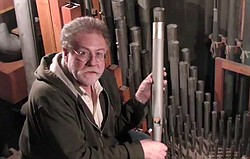
Nicholas Thompson-Allen is the chief of Thompson-Allen Co. and the son of its founder. He is spending a good deal of time in town lately, overseeing the organ’s removal. He was at the historic auditorium Monday, where workers were removing the organ and its blower.
His company has restored 16 Skinner pipe organs of comparable size, but the Stambaugh instrument is bigger than most, Thompson-Allen said.
Water, most likely from a leaky roof many years ago, flooded a wooden chest that surrounds the pipes, causing distortion and diminishing the sound. Thompson-Allen will flatten the wood and replace the leather membrane.
“These organs are supposed to be restored after 80 or 90 years anyway,” said Thompson-Allen, adding that even if there were no water damage, the organ would still be due for an overhaul.
Stambaugh already has received a $750,000 grant from the Bradley Foundation of Minnesota.
It must now raise the remainder of the cost — $535,000 — before the project is complete, said Phil Cannatti, executive director of Stambaugh.
Thompson-Allen told Cannatti about the Bradley Foundation, which has an interest in the refurbishment of historic instruments. Stambaugh applied for and received a grant.
The Stambaugh pipe organ has close to 4,000 pipes, which range from pencil-sized to 30 inches in diameter and 30 feet long. The pipes are arranged in wooden enclosures on either side of the stage. A giant blower in the basement — which is being refurbished by Lemsco Inc. of Toledo — sends air into the pipes. A system of vents and stops that are operated by a keyboard create the tones.
The original 1926 keyboard, which looks like a large wooden organ, will be renovated and placed at center stage, at orchestra pit level, when the job is complete.
Stambaugh officials had said they expect musicians worldwide will want to play the pipe organ with orchestral accompaniment once the work is complete.
Cannatti said the organ was last played at the Carols and Cocoa Christmas event in December. But he pointed out that no one involved with the auditorium today has ever heard the organ at its peak power.
“We don’t know how long it’s been since the organ was damaged,” he said. “It was probably in the 1940s.”
The organ is only at about 25 percent of its full capacity, he said.
The Thompson-Allen Co. already has removed half of the pipes and sent them to its Connecticut plant. It took about five truckloads to transport the dismantled pieces.
The company will return this summer to remove the rest of the organ, Cannatti said.
Stambaugh is filming the project in hopes of getting a documentary made by Western Reserve Media, the Public Broadcasting System station, Cannatti added.
dastolfo@vindy.com