 43
43

King of Pop leaves musical legacy
 Photo
Photo
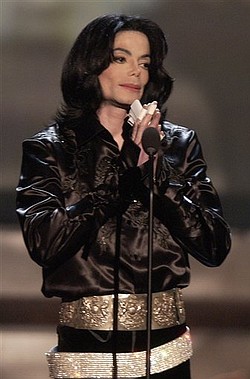
FILE - In this Monday, Oct. 27, 2003 file picture, Michael Jackson thanks the audience during the Radio Music Awards at the Aladdin Hotel in Las Vegas. Jackson has died in Los Angeles at age 50 on Thursday, June 25, 2009. (AP Photo/Joe Cavaretta)
 Photo
Photo
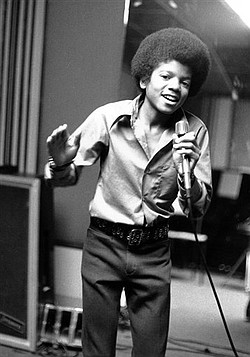
FILE - In this 1972 file photo, singer Michael Jackson at age 13, the youngest member of the singing group Jackson Five, sings in his home in Encino, Ca. (AP Photo, file)
- More on Jackson's life and death
-
- VIDEO: Michael Jackson Remembered
- VINDY STORY: Trip down memory lane finds a personable, approachable star
- VINDY STORY: Valley fans hail Jackson's legacy
- VINDY STORY: Valley fans celebrate Jackson
- AP STORY: Jackson’s public memorial takes solemn, spiritual turn
- AP STORY: Jackson’s mom gets temporary custody
- AP STORY: At BET Awards, Jackson’s legacy honored
- AP STORY: Fans mourn ‘King of Pop’
- TIMELINE: The life of Michael Jackson
- PHOTOGALLERY: Michael Jackson Obituary Gallery
- VIDEO: Local hip-hop remembers MJ
- LINK: Michael Jackson iTunes Store (opens in iTunes app)
- LINK: Complete Bio and music selection
- LINK: Michael Jackson YouTube channel
- VINDY STORY: Good night Michael
- VINDY STORY: The Valley remembers megastar
- TIMELINE: Career highlights
LOS ANGELES (AP) — Michael Jackson, the “King of Pop” who once moonwalked above the music world, died Thursday as he prepared for a comeback bid to vanquish nightmare years of sexual scandal and financial calamity. He was 50.
Jackson died at UCLA Medical Center after being stricken at his rented home in Holmby Hills. Paramedics tried to resuscitate him at his home for nearly three-quarters of an hour, then rushed him to the hospital, where doctors continued to work on him.
“It is believed he suffered cardiac arrest in his home. However, the cause of his death is unknown until results of the autopsy are known,” his brother Jermaine said. Police said they were investigating, standard procedure in high-profile cases.
Jackson’s death brought a tragic end to a long, bizarre, sometimes farcical decline from his peak in the 1980s, when he was popular music’s premier all-around performer, a uniter of black and white music who shattered the race barrier on MTV, dominated the charts and dazzled even more on stage.
His 1982 album “Thriller” — which included the blockbuster hits “Beat It,” “Billie Jean” and “Thriller” — is the best-selling album of all time, with an estimated 50 million copies sold worldwide.
At the time of his death, Jackson was rehearsing hard for what was to be his greatest comeback: He was scheduled for an unprecedented 50 shows at a London arena, with the first set for July 13.
As word of his death spread, MTV switched its programming to play videos from Jackson’s heyday. Radio stations began playing marathons of his hits. Hundreds of people gathered outside the hospital. In New York’s Times Square, a low groan went up in the crowd when a screen flashed that Jackson had died, and people began relaying the news to friends by cell phone.
“No joke. King of Pop is no more. Wow,” Michael Harris, 36, of New York City, read from a text message a friend had sent him. “It’s like when Kennedy was assassinated. I will always remember being in Times Square when Michael Jackson died.”
The public first knew him as a boy in the late 1960s, when he was the precocious, spinning lead singer of the Jackson 5, the singing group he formed with his four older brothers out of Gary, Ind. Among their No. 1 hits were “I Want You Back,” “ABC” and “I’ll Be There.”
He was perhaps the most exciting performer of his generation, known for his backward-gliding moonwalk, his feverish, crotch-grabbing dance moves and his high-pitched singing, punctuated with squeals and titters. His single sequined glove, tight, military-style jacket and aviator sunglasses were trademarks, as was his ever-changing, surgically altered appearance.
Jackson ranked alongside Elvis Presley and the Beatles as the biggest pop sensations of all time. He united two of music’s biggest names when he was briefly married to Presley’s daughter, Lisa Marie, and Jackson’s death immediately evoked comparisons to that of Presley himself, who died at age 42 in 1977.
As years went by, Jackson became an increasingly freakish figure — a middle-aged man-child weirdly out of touch with grown-up life. His skin became lighter, his nose narrower, and he spoke in a breathy, girlish voice. He often wore a germ mask while traveling, kept a pet chimpanzee named Bubbles as one of his closest companions, and surrounded himself with children at his Neverland ranch, a storybook playland filled with toys, rides and animals. The tabloids dubbed him “Wacko Jacko.”Jackson caused a furor in 2002 when he playfully dangled his infant son, Prince Michael II, over a hotel balcony in Berlin while a throng of fans watched from below.
In 2005, he was cleared of charges he molested a 13-year-old cancer survivor at Neverland in 2003. He had been accused of plying the boy with alcohol and groping him, and of engaging in strange and inappropriate behavior with other children.
The case followed years of rumors about Jackson and young boys. In a TV documentary, he acknowledged sharing his bed with children, a practice he described as sweet and not at all sexual.