 43
43

Don't let your set go to the graveyard
If the analog TV works and you’re not keeping it for yourself, donate it for reuse, officials urge.
VINDICATOR STAFF WRITER
TV Recycling
 Video
Video
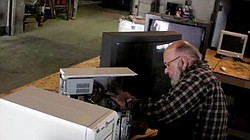
The upcoming switch from analog to digital TV has resulted in more recycling of old TV's for one Valley business.
YOUNGSTOWN — With analog television broadcasting ending Friday, consumers are considering their options about what to do with an analog TV that’s not going to be hooked up to a paid cable service or satellite system.
If the TV works, the best option is to reduce the waste disposal stream by keeping it yourself and using a government-issued coupon toward the purchase of a converter box for it, recycling officials say.
If you’re not going to keep it, the next best thing is to donate the working TV to a charity for reuse by someone else.
If it doesn’t work, take the TV to a recycling collection drive or to an electronics recycler to ensure proper and environmentally safe disposal of its toxic components, including lead, without unnecessarily using landfill space.
Don’t, however, put it at the curb for the trash hauler to smash in a truck before dumping it into a landfill, or, worse yet, having it incinerated.
All this is consistent with the Mahoning County Recycling Division slogan: Reduce, reuse and recycle, said Jim Petuch, director of the recycling division, also known as the Green Team.
Petuch and Gary Piskor, owner of Val-E-Tronics, an electronics recycling company, said almost any analog TV will work with a converter box.
If you’re not keeping the TV, “Reuse, if it’s working, is the best option,” said Sarah E. Ellis, manager of Youngstown State University’s YSU re:Create program, a Green Team-funded program, which promotes materials exchange and reuse.
She suggested donating the working TV to the Rescue Mission of the Mahoning Valley, which gives TVs to needy people, or donating it to the Easter Seals garage sale in Warren, where proceeds from its sale will support rehabilitation programs for disabled people.
Petuch recommended donating it to the ReStore in Struthers, where sale proceeds benefit Habitat for Humanity, which is the store’s sponsor.
“We don’t turn people away because they can’t pay, so that’s why it’s so important for us to have the garage sale to help recover the costs,” of uncompensated services, said Jodi Harmon, development and public relations coordinator for Easter Seals.
Uncompensated services at Easter Seals of Mahoning, Trumbull and Columbiana Counties totaled $540,000 last year, she added.
“The last time I looked, there must have been a couple of dozen TVs,” some of them noncable-ready console TVs, in the ReStore, said Dr. Stephen Hanzely, a Habitat volunteer and former Habitat president.
The ReStore wants more donated working TVs that are cable-ready, but prefers not to receive console televisions, which “are a little more difficult to sell,” he said.
Although it prefers to receive only working TVs, the ReStore has an unemployed volunteer who repairs TVs and radios, including antique radios, Hanzely said.
Petuch said he prefers that only nonworking TVs be brought to electronics recycling drives, such as the one that will be from 10 a.m. to 2 p.m. July 11 at the county’s South Side Annex, 2801 Market St. Another such drive will be in October, Petuch added.
“Please don’t bring working TVs when you could donate them to these worthy charities,” Petuch said.
Fees based on the screen size must be charged to people bringing TVs to such drives and to recycling companies to cover the costs of deconstruction and recycling, Petuch said.
“There is a fee, but you are guaranteeing that it’s going to be disposed of safely and properly,” Ellis said.
Go Surplus Computers of Salem receives the TVs recycled in Green Team drives and either deconstructs them or sends them to an end-user here or overseas, Petuch said.
In 2007, before the recession began, China, Vietnam, India and Malaysia were buying TVs for reuse, Petuch said. China stopped buying after the 2008 Olympics, but it has since begun buying them again, he added.
Ellis and Petuch can’t emphasize enough the environmental perils of putting TVs to the curb for the trash hauler to pick up.
A large television with a standard cathode-ray tube contains about eight pounds of lead to protect the viewer from the tube’s radiation, Ellis noted.
“When the truck squishes it, all that can come out, and it can leach after it’s put into a landfill, so we definitely want to keep that lead out of our landfills and dispose of it properly,” Ellis said.
Petuch gives the same reuse and recycling advice that applies for TVs for old computer monitors, urging people to give monitors that work to friends, family members or charities, and to recycle those that don’t work.
The same lead hazard concerns that apply to TVs apply to cathode- ray tube monitors, he said.
Ohio should soon enact a law banning dumping of TVs and other electronic items in landfills or burning them in incinerators, Petuch said.
“Then people would be forced to have some environmental stewardship when it comes to electronics,” he added.
Petuch also said he would like to see manufacturers and retailers buy back at low prices the TVs they make and sell so they can be recycled when they no longer work.
SEE ALSO:Avalanche of cast-off TVs expected.
RECYCLING
Mahoning Co. Green Team Electronics Collection
•South Side Annex, 2801 Market St., Youngstown; 10 a.m. to 2 p.m., July 11.
- TVs under 21 inches will be collected for a fee of $5 each; $10 each for 21-to 31-inch sets; and $20 for sets more than 31 inches.
- Call (330) 740-2060 for more information.
GO SURPLUS COMPUTER
•429 E. State St., Salem; 11 a.m. to 7 p.m., Monday through Friday; 10 a.m. to 4 p.m., Saturday.
- Call (330) 337-8355 for more information.
- Charge for TV set disposal, $5 to $20 based on size and type.
- Will pick up for a fee.
Val-etronics
•1740 Mahoning Ave.; 9 a.m. to 6 p.m., Monday through Friday; 10 a.m. to 4 p.m. Saturday.
- Call (330) 797-7550 for more information.
- Charge for TV set disposal, $15 for TVs 31 inches or smaller; $25 for TVs more than 31 inches.
- Will pick up from seniors and shut-ins for a fee.
DONATION SITES
The Rescue Mission
•2246 Glenwood Ave., Youngstown; 9 a.m. to 4 p.m., Monday through Friday.
•962 Martin Luther King Jr. Blvd., Youngstown, anytime.
- Call (330) 744-5485 for pickup.
Easter Seals garage sale
•1983 Ridgeview Plaza, rear, Warren; donation hours are noon to 5 p.m., Monday through Friday.
- Garage sales, 9 a.m. to 8 p.m., Saturday; 9 a.m. to 5 p.m., July 4, at Ridgeview Plaza.
- Call (330) 369-1324 for pickup.
- No console or floor model TVs.
Habitat for Humanity ReStore
•480 Youngstown-Poland Road, Struthers; 9 a.m. to 4 p.m., Wednesday through Saturday.
- Call (330) 755-2232 for more information.
- TVs must be cable ready.
Source: YSU reCREATE
The Digital TV Transition
Frequently asked questions
I have an older style, working TV with an antenna. Will I have to get rid of the TV to receive broadcasts?
NO. You will need a digital-to-analog converter box costing between $40 and $70, which is much less than the cost of a new TV. Coupons worth $40 toward the purchase of a converter box may be obtained online at www.DTV2009.gov, or call (888) 388-2009.
Do I have to purchase a high definition TV?
NO. You need a digital TV, which is not always an HDTV and is less expensive.
If I have a paid TV service, such as cable or satellite, do I need a converter box?
NO. You will receive the digitally transmitted signal through your carrier.
Is it better for the environment to dispose of my old TV, even though it still works and buy a new TV?
NO. Disposing of TV sets is not a good environmental practice as there are harmful components, such as lead in the picture tube, that can cause pollution and health problems. It is better to keep the TV set, get a converter box, and save money. You can donate working TV sets to several charities.
When my TV stops working and cannot be repaired, should I recycle it?
YES. The Mahoning County Green Team has electronic recycling drives throughout the year, to which people can take their nonworking TVs. Since the dismantling process is expensive, there is a charge based on the size of the picture tube. However, that is a small price to pay to protect the environment.
Source: Mahoning County Recycling Division (Green Team)