 43
43

TRASH FREE PARKS
Carry Out Your Trash
 Video
Video
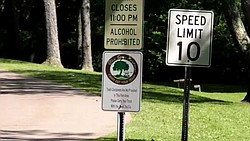
Ohio State Parks have started a program requiring visitors to take their trash with them.
 Photo
Photo
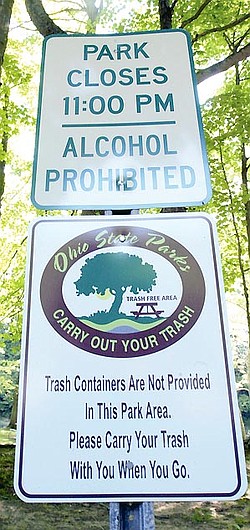
"Carry Out Your Trash" signs are on display at Beaver Creek State Park.
 Photo
Photo
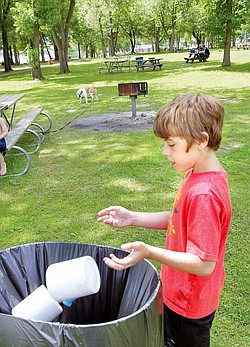
Coulton Lockner, 12, of Lake Milton, tosses trash into a barrel at Lake Milton State Park. Lake Milton is one of the area parks not participating in the "Carry In Carry Out" program.
 Photo
Photo
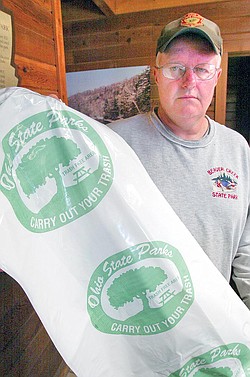
Bill Dunlap, an employee of Beaver Creek State Park, displays trash bags provided to park visitors. The park is in the second year of the “Carry In, Carry Out” program.
Carry in, carry out: Participating parks
Thirty parks are involved with the “Carry In, Carry Out” program sponsored by the Ohio Department of Natural Resources, which removes garbage cans from the parks and requires patrons to bring their own trash bags.
CENTRAL REGION
Alum Creek
Deer Creek
Delaware
NORTHEAST REGION
Beaver Creek
Jefferson Lake
Geneva
Guilford Lake
Portage Lakes
Quail Hollow
NORTHWEST REGION
Grand Lake St. Marys
Harrison Lake
Independence Dam
Indian Lake
Mary Jane Thurston
Maumee Bay
Van Buren
SOUTHEAST REGION
Burr Oak
Forked Run
Hocking Hills
Lake Logan
Strouds Run
SOUTHWEST REGION
Adams Lake
Caesar Creek
Cowan Lake
East Fork
Hueston Woods
Paint Creek
Rocky Fork
Shawnee
Stonelick
Source: ODNR
The program is designed to reduce waste and cut costs, officials said.
By Jon Moffett
Instead of throwing away money for sanitation costs, many state parks have elected to dump their garbage cans.
The garbage can ban has been implemented in 30 parks statewide as part of a program by the Ohio Department of Natural Resources. The “Carry In, Carry Out” program requires visitors to supply their own trash bags and take garbage with them when they leave the park.
“It’s been really well received in the areas that we’ve implemented it,” ODNR spokeswoman Beth Ruth said of the program. “We found that as people become aware, they are seeing the benefits.”
Those benefits include reducing litter, beautifying the parks and saving money, Ruth said.
Two of the four state parks in the tri-county area are participating in the optional program. Beaver Creak and Guilford Lake state parks in Columbiana County have ditched the dumpsters while Lake Milton in Mahoning County and Mosquito Lake in Trumbull County still have their cans handy.
Officials with the participating parks said the program has been successful despite early skepticism.
“When we first talked about it, there was a fear of the general public saying they’re just going to leave their garbage here,” said Todd Metz, park manager of Beaver Creek and Guilford Lake. “That is the biggest fear, that the park would be overwhelmed with trash. Our maintenance guys were the first to say that, and now they’re the first ones to say this is a great idea.”
Patrons have mixed feelings.
Ginny Helmick, 65, of Canfield, took her husband and two grandchildren to Beaver Creek for a picnic last week. To her surprise, the trunk of her car became a temporary trash bin.
“It’s nice to have a place to just to put the garbage,” she said. “They have lots of picnic tables, but no place to put your garbage. It’s pretty inconvenient.”
Conversely, Brian Joseph, 41, of Middleburg Heights, said he has no issue with the program. He was visiting Late Milton with his nephews. One of his nephews, Colton Lockner, 12, of Lake Milton, said the benefits stretch even beyond aesthetics.
“You could recycle it instead of throwing it away,” he said.
Along with keeping the parks green, the program should help save a little green too.
Ruth said the program saved about $56,000 last year and that figure should increase once more parks agree to participate.
Officials from both Lake Milton and Mosquito Lake said they plan to participate next year.
Ruth said the idea is not exclusive to Ohio and about 20 other states — Delaware, New Jersey and Wisconsin to name a few — have similar programs.
The hope is that by removing garbage cans, the parks can also remove much of the excess clutter that comes with them, Ruth said. Ruth said park officials had complained in the past about raccoons and other animals knocking the cans over looking for food. As well as creating a mess, foraging for leftovers is harmful to the animals.
“It has provided us a way to have a partnership between the parks and the visitors, as they’re encouraged to participate and learn about recycling and environmental issues,” Ruth said. “And when you think about the animals that would be a attracted to trash, it’s a benefit because you’re not as likely to have the human and nature interaction.”
Metz, who worked as an official with a Maryland state park before moving to Ohio, said animals getting into the trash has been an issue.
“You’d put a couple of trash cans in the park and you’d have a couple of bears come in and make a mess,” he said. “But also, the animals start to become dependent on that food source. And once they become dependent, they start to look at humans as food sources, which is dangerous for both.”
jmoffett@vindy.com