 43
43

Life after death for King of Pop
 Photo
Photo
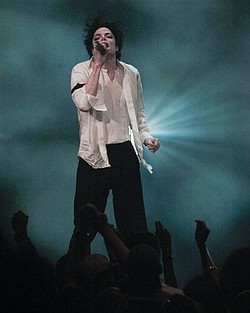
FILE - In this Thursday, Sept. 7, 1995 file picture, Michael Jackson performs during the 1995 MTV Video Music Awards at Radio City Music Hall in New York. Jackson has died in Los Angeles at age 50 on Thursday, June 25, 2009. (AP Photo/Bebeto Matthews)
- More on Jackson's life and death
-
- VIDEO: Michael Jackson Remembered
- VINDY STORY: Trip down memory lane finds a personable, approachable star
- VINDY STORY: Valley fans hail Jackson's legacy
- VINDY STORY: Valley fans celebrate Jackson
- AP STORY: Jackson’s public memorial takes solemn, spiritual turn
- AP STORY: Jackson’s mom gets temporary custody
- AP STORY: At BET Awards, Jackson’s legacy honored
- AP STORY: Fans mourn ‘King of Pop’
- TIMELINE: The life of Michael Jackson
- PHOTOGALLERY: Michael Jackson Obituary Gallery
- VIDEO: Local hip-hop remembers MJ
- LINK: Michael Jackson iTunes Store (opens in iTunes app)
- LINK: Complete Bio and music selection
- LINK: Michael Jackson YouTube channel
- VINDY STORY: Good night Michael
- VINDY STORY: The Valley remembers megastar
- TIMELINE: Career highlights
By Karen Heller
Michael Jackson is still dead.
The Michael Jackson Industrial Death Complex, however, thrives in its infancy. Dead Michael is fuel for tabloids, chat shows, and cable news because, clearly, the economy, two wars, and nuclear-arms talks are not newsy enough.
For a man who spoke so rarely, and in such a childish hush, Jackson continues to cause a racket. On Sunday, the Rev. Al Sharpton called for a commemorative stamp, urging the Postal Service to waive its usual five-year waiting period after a death. He also asked for a national day of mourning, prophesying that the memorial would “celebrate Michael’s life and will affect all nations, all nationalities, and all religions.”
An exquisite dancer, Jackson was the ideal performer to give birth to music’s video era. Would “Thriller” have sold so brilliantly without a nascent MTV? Jackson was abetted by a burgeoning entertainment press obsessed with sales figures, albums sold, records broken.
This success was impossible to duplicate, but who knew it would be followed by Jackson’s Twilight Zone? His once-handsome face morphed, by will and wallet, into an ever-changing grotesque, neither male nor female, white nor black, more cadaverous than human.
Increasingly pale and always thin, Jackson became that strangest of performers, a silent star. We saw him only in glimpses. He rarely performed, producing only five albums in a quarter-century.
The surgical mask didn’t help, a sign of his mounting fears and shaky health. Nor did Jackson’s unconvincing alliances with Lisa Marie Presley and later his dermatologist’s nurse, as if only the help, a member of his sycophantic court, could serve as consort.
Burdens at a young age
As a child, Jackson was asked to grow up quickly, carrying the fortunes of his huge family on his young shoulders. As an adult, he grew increasingly childlike, seemingly incapable of coping with the outside world. His finances became a mess, as if he couldn’t handle such responsibility. Though he was acquitted in 2005 of child molestation charges, his reputation was reduced to tatters.
And so, he retreated. He became a man without a country, fleeing to Bahrain and other foreign shores, where he was met with adulation and less scrutiny. Later, he lost his make-believe home, the Neverland Ranch.
That made his end stunning, because he had already faded before us. At 50, he was already a specter, a memory, even with the planned “final curtain call” London concert series this summer, his first set of shows in a dozen years.
All this created the ideal environment for the rise of the Dead Michael industry. The stage is primed for several stories to dominate news cycles for weeks, if not months: the legal morass over the estate, potential custody battles (and already raised questions of paternity), the toxicology vigil, and investigation of complicity by myriad doctors. There’s also the troubling issue of his children’s living with their grandparents after Jackson claimed in television interviews that he had been emotionally and physically abused by his father.
Michael the myth was born with “Thriller” in 1982, during what Tom Wolfe labeled “the decade of plutography,” a pornlike obsession with the rich and famous.
That’s nothing compared to necroplutography, the fascination with dead celebrities, Marilyn, Elvis and Diana, summer deaths all. They’re vessels for conspiracy theories, vast canvases for poachers, all potential gold. Dead Michael is primed to give Dead Elvis a run for the money and the record books.
Michael Jackson may rest in peace, but his memory? Never.
X Karen Heller is a columnist for Philadelphia Inquirer. Distributed by McClatchy-Tribune Information Services.