 43
43

Budget prevents falcon banding
Peregrine Falcon Nest
 Gallery
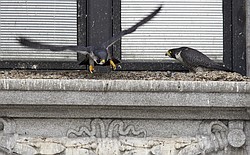
Peregrine Falcon Nest at the Mahoning County Courthouse, Youngstown, OH.
Peregrine Falcon Nest
 Video
Video
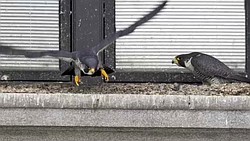
Peregrine Falcons nest on a 4th floor window ledge of the Mahoning County Courthouse in Youngstown, OH.
Signs are posted in the library asking patrons not to disturb the birds.
YOUNGSTOWN — Wildlife officials’ ability to monitor three peregrine falcons, hatched in June on a Mahoning County Courthouse window ledge, is being compromised by the state’s budget woes.
Dan Kramer, an Akron-based regional wildlife management supervisor for the Ohio Department of Natural Resources, said he has had to cancel the trip he planned to make today to band the newborn birds because the state’s interim budget forbids nonessential travel by state employees.
The birds can’t be banded after Monday because they’ll develop to the point where they’ll be too mobile to catch easily and could fall off the window ledge in a banding attempt, Kramer said Tuesday.
“The window ledge is fairly narrow, and there’s no lip on it,” Kramer said, adding that outward cranking windows make the job more difficult. The chicks won’t be ready to fly until the last week of this month, he added.
Kramer said his colleague, wildlife biologist Damon Greer, found the adult birds “quite aggressive” when Greer visited the nest last week. One of the adults nearly came into the fourth-floor law library window, Kramer said.
“Peregrines are very protective of the nest site and of the young,” Kramer said, adding that Greer found the adults and newborns healthy last week.
Wearing leather gloves and holding a transparent plastic shield to foil attacks by the adult birds, the wildlife specialists take the chicks indoors to determine their sex, put identification bands on their legs and draw a blood sample for DNA analysis before releasing them.
The color-coded identification bands carry letters and numbers large enough to read with binoculars or a spotting scope, Kramer said. The DNA samples allow wildlife officials to determine the chicks’ genetic relationship to other peregrines in North America, he added.
Because of increases in the peregrine population, the federal government upgraded this species from endangered to threatened status last year, but it is still illegal to kill or harm peregrines or to harm their eggs or nests, Kramer said.
Peregrines catch ducks, pheasants, pigeons and other birds in midair, and the ones at the courthouse have already substantially reduced the pigeon population there.
In an earlier interview, Greer said he believes the pair of adult peregrines at the courthouse is the same pair that nested at the Stambaugh Building for several years and made a failed nesting attempt earlier this year at the Metropolitan Tower.
The eggs got wet and chilled, and the embryos died in the failed attempt, Kramer said.
“This is somewhat of a late nesting attempt,” Kramer said of the peregrines at the courthouse.
However, Kramer said he doesn’t believe their late hatching will put the newborns at a survival disadvantage.
“They’ll have plenty of time to develop their hunting and flying skills before the fall comes and their food becomes a little more scarce,” Kramer said, referring to the fall migration that reduces the local bird population.
“I don’t like to disturb them,” Anna Paczelt, law librarian, said of the peregrines. Paczelt keeps the windows closed and the shades drawn, keeping the birds out of sight, and she has posted signs asking patrons not to disturb the nest.
“We heard a lot of squeaks,” after the birds hatched, she said. “You could hear them even across the street.”
milliken@vindy.com