 43
43

Director talks community organizing
 Photo
Photo
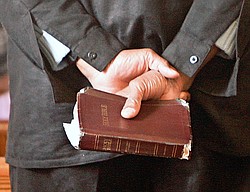
One of the members with a bible in his hand during opening prayers at Holy Trinity Missionary Baptist Church
 Photo
Photo
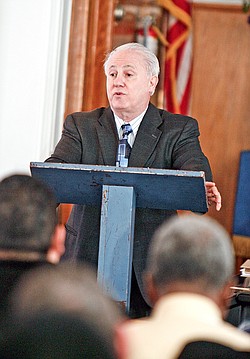
The Interdenominational Ministerial Alliance will host Gregory A. Galluzzo, national director of the Gamaliel Foundation in Chicago. Galluzzo recruited and trained President-elect Barack Obama in the skills of faith-based community organizing.
A community organizing proponent who worked with a young Obama urged his audience to shape their own destiny.
YOUNGSTOWN — When Gregory A. Galluzzo talks about the qualities that made President-elect Barack Obama a good community organizer, he’s in essence telling those listening what attributes they need to develop and fine-tune.
The national director of the Gamaliel Foundation in Chicago spoke to about 40 people Monday at Holy Trinity Missionary Baptist Church at a meeting of the Interdenominational Ministerial Alliance. The foundation is a community organizing network representing more than a million multifaith, multiracial and churchgoing people who work on campaigns for social justice.
It is the foundation where Obama acquired his training and worked as a community organizer.
“When I first met Barack, I didn’t know he would be a great person,” Galluzzo said, noting that he meant no disrespect by using the president-elect’s first name.
Galluzzo said he knew the president-elect when he was just beginning his career, and the president-elect has acknowledged Galluzzo and Gerald “Jerry” Kellman, a community organizer in Chicago, as mentors.
“Barack shows respect for the people he meets,” Galluzzo said.
He noted that the graduate of Columbia University and Harvard Law School would have landed any high-paying corporate job he applied for, but he decided on another path. The first step was answering an ad to be a community organizer with Developing Communities Project in Chicago. He was in his 20s.
“He is a great communicator," said Galluzzo. “When you’re with him, he has the ability to make you feel good about yourself.”
Galluzzo said that although Obama attended private and Ivy League schools, he never has come across as arrogant. The speaker said that the new president has the ability to relate to people in all walks of life.
“He’s a hard worker, and he went into dangerous places in Chicago. He’s also very honest,” Galluzzo said, recalling an instance when community organizer Obama couldn’t meet his payroll and asked Galluzzo for a loan. “He paid it back on the very day it was due.”
Galluzzo said that the president-elect has the knack of “making people feel that they have something to contribute” and that “ordinary people can do extraordinary things.”
Galluzzo said that community organizing is “empowering people” and “challenging them to express their gifts.”
He noted that when people feel important, they feel like they can make a contribution.
“They [the people] were the ones making the changes possible,” Galluzo said of the work Obama did in Chicago. “He gave them the excuse to do that.”
Galluzzo told his audience that community organizing is based on the idea that “people’s needs aren’t being met.” But, he emphasized, the residents of the community “aren’t helpless but gifted” because by tackling and solving the problems they better their own lives.
The speaker said it doesn’t make sense to start from scratch when there are institutions in the community that are already established.
“Churches are well-organized,” he said. "It makes sense to train those people who are already organized.”
By their nature, churches are interested in advancing social justice. “Should the church help the government or hold the government accountable?” Galluzzo asked, and answered: “Churches should challenge the government.”
Galluzzo pointed out that people worked as community organizers long before the term was in vogue. He said those who organized the Boston tea party, women’s rights and civil rights movements lived the term “community organizer.”
“In that tradition, faith compels us to change the world,” he said. “There’s power in organization. It’s vital to invest in relationships and spend time building relationships.”
Galluzzo also said it is the responsibility of people to “ward off sociological diseases that permeate the community.” He also said parents who complain about a school system must get involved, ask questions and be part of the solution. He also noted that if there’s a drug house on your block, make calls to the police — don’t sit back and watch.
linois@vindy.com
SEE ALSO: How faith based training works.