 43
43

Tenants sing praises of Oakhill Renaissance Place
 Photo
Photo
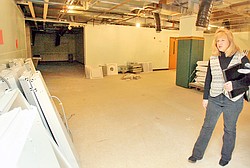
Saving and reusing old doors and lighting - Tracie Caglic with the architech Jaminet

 Video
Video
Tenants sing praises of Oakhill Renaissance Place
Oakhill Renaissance Place is a work in progress, but it’s already getting rave reviews from Mahoning County officials, their architects and the people who work there.
“It’s a 10 out of 10,” said Barry Landgraver, director of the county’s Veterans’ Service Commission. The commission, which is Oakhill’s newest occupant, opened for business there Dec. 22 after moving from the county’s South Side Annex at 2801 Market St.
Located at 345 Oak Hill Ave., the five-story, 338,000-square-foot Oakhill Renaissance Place is the former Forum Health Southside Medical Center.
Saving the complex from abandonment, the county bought the former hospital for $75,000 in U.S. Bankruptcy Court, subject to all liens, including back real estate taxes and an Ohio Department of Development loan.
“The facilities are much better and more practical than we had at the annex,” Landgraver said.
He contrasted the commission’s readily handicapped-accessible first-floor offices at Oakhill with its second-floor offices in the South Side Annex, which were a long walk from the parking lot.
VSC provides veterans’ benefits counseling, transports veterans to Cleveland-area U.S. Department of Veterans Affairs medical centers and provides temporary emergency cash assistance to needy veterans. Several parking spaces adjacent to Oakhill’s Entrance A, where the commission is located, are reserved for disabled veterans.
The new offices also offer better privacy for veterans than the annex’s high-walled cubicles, Landgraver said.
When they visit the commission, veterans can also obtain birth certificates from the city health department and apply for Job and Family Services assistance because those agencies are also at Oakhill.
“One-stop shopping is going to be great,” Landgraver said, echoing a theme often extolled by county officials and Oakhill tenants.
Not everyone agreed in the beginning that the building purchase was the right move.
Michael V. Sciortino, county auditor; John B. Reardon, who was county treasurer in 2006; and county Commissioner John A. McNally IV opposed the purchase, citing undetermined costs associated with buying, operating and maintaining the former hospital.
When the county bought the building, it already housed the county coroner’s office, the city health department and the Mahoning-Youngstown Community Action Partnership, (MYCAP), which remain there today.
In July 2007, the county relocated its Department of Job and Family Services to Oakhill from rented quarters at Garland Plaza on the city’s East Side.
The county settled a breach-of-lease lawsuit from the Cafaro Co., JFS’ former landlord at Garland, for $913,590, in exchange for Cafaro’s agreement to drop its appeal of its loss in a taxpayers’ lawsuit, in which the company tried to rescind the county’s purchase of Oakhill.
‘This is a palace’
“Garland was a zero. This is a 91‚Ñ2 or 93‚Ñ4,” Tim Komara, a case manager at JFS’ Child Support Enforcement Agency, said when he was asked to compare Garland with Oakhill.
“There’s no comparison. This is a palace. It’s beautiful. It’s clean. We have windows. It’s safe,” and centrally located, said Komara, an executive board member of American Federation of State, County and Municipal Employees Local 3577, which represents CSEA workers.
“We have a parking deck. Our cars are safe and out of the elements,” he added.
“There were health and safety issues in that facility — health hazards from mold,” county Commissioner Anthony T. Traficanti said of JFS’ former quarters at Garland Plaza, where the county incurred rent, security, maintenance and utility costs.
“This was the best decision, and I stand by my decision. This is a great project for this community,” Traficanti said of Oakhill.
“Sure you’re going to have repairs,” Traficanti said of the former hospital complex, which was built in stages between 1915 and 1972.
However, Traficanti said, “We own the property. We maintain it. We manage it.” The Oakhill acquisition saved the county the expense of having to immediately relocate the coroner’s office if Oakhill had been abandoned, he added.
County Administrator George J. Tablack estimated relocating the coroner would have cost $2 million.
If JFS had stayed at Garland, its annual occupancy costs today would have been about $1.5 million, but at Oakhill, that number has been $1.2 million over the past year, Tablack said. As Oakhill’s occupancy grows, these costs will be spread across more agencies, he added.
Auditorium called excellent
One of Oakhill’s highlights is the frequently used former hospital auditorium, known as the Renaissance Conference Center, whose use is shared by Oakhill occupants.
“It really works for us,” said Elaine Yeaton, staff training coordinator for MYCAP’s Head Start program.
Rating the auditorium as “100 percent excellent,” Yeaton said it is clean and comfortable and has good audio, video and lighting systems, all in good working order, and the facility is conducive to productive employee workshops.
“Because the building is so wonderful and because we have such a good relationship with the county, we’re also exploring taking on additional space,” said Lois Clark, director of the local Head Start pre-school program, which serves more than 1,000 children.
MYCAP occupies a separate former hospital administration building and is negotiating with the county to move its Home Weatherization Program to Oakhill.
“Things here are outstanding,” said Neil Altman, city health commissioner for the past 28 years, who consolidated three former city health department locations under one roof at Oakhill in 1999. The health department uses the former hospital rooms in as-is condition.
Altman said Oakhill is far superior to his former office on the seventh floor of city hall, where rainwater leaked in from the roof, parts of the ceiling were collapsing and tattered carpet was repaired with duct tape.
The county’s Oakhill project is being undertaken in three phases, Tablack said.
Phase one was to relocate JFS to temporary quarters at Oakhill while its permanent quarters there are under renovation.
Phase two is to relocate the remaining occupants of the South Side Annex – the county’s recycling division, auto title office, board of elections and adult day care center and the Mahoning Valley Law Enforcement Task Force – to Oakhill and close the annex by the end of 2009, Tablack said.
The annex is a former department store with difficult vehicular access from a busy intersection and inadequate parking, and the county would have to spend $4 million for improvements if it were to stay there, Tablack said. After the annex is emptied and closed, the county will try to sell the annex at auction, he added.
Phase three is to place financially viable nonprofit agencies at Oak-hill, Tablack said.
1,000 potential workers
With about 500 people working at Oakhill now, Tablack predicted that number will double in two years.
Tablack said he wants Gov. Ted Strickland’s help in relieving the county of Oakhill’s real estate tax burden, which accumulated under the building’s bankrupt former owner, and in getting the Adult Parole Authority to move its local offices to Oakhill, where parolees can also visit JFS and VSC offices.
County officials say Oakhill is functioning well for its intended purpose as a county office complex.
“I think it’s doing extremely well, considering the fact that there are ongoing renovations,” said Atty. David Comstock, chairman of the county building commission, which is overseeing Oakhill renovations.
Various JFS offices have been moved to temporary space within the former hospital pending completion of renovations for their permanent office space within that building.
“You have to maintain the existing business process as you continue to renovate for those same tenants,” Tablack said.
“As far as I can see, it’s functioning very well,” said Pete Triveri, county facilities director. Occupants tell him the county has more maintenance staff and responds faster to complaints than the bankrupt former Southside Community Development Corp., Triveri said.
“We have no problems renovating any of it,” said Raymond Jaminet, the county’s lead architect. “The earliest construction was as good as the latest construction,” he added.
“Structurally, the building is in excellent condition. You couldn’t find another building like this in Mahoning County,” said Tracie A. Kaglic, another architect working on the project.
Financing costs
The county borrowed $5 million for 20 years in December 2006, initially intending to use all of it to renovate all 100,000 square feet of JFS’ permanent space at $50 per square foot, Tablack said.
After moving to temporary quarters at Oakhill, however, JFS decided it liked most of its space as-is and needed to renovate only 35,000 square feet of its space at a cost between $2 million and $2.5 million, he added.
That left the remaining money to perform improvements, such as the $379,000 replacement of 28,000 square feet of roof this spring and renovations for other county offices, he said.
Kaglic said the roof repairs, new restroom installations and renovations for the recycling division, auto title department and board of elections can all be performed within the original $5 million allotment.
Tablack said the money was borrowed for 20 years because the county expects to benefit from those improvements for two decades or longer.
During the renovations, doors and lighting fixtures are being salvaged and stockpiled for reuse to save money, Kaglic said. Bids for the renovations have been coming in 25 percent to 30 percent below the architects’ estimates, she added.
“We are watching all our costs and trying to keep those costs as minimal as possible,” she noted.
milliken@vindy.com