 43
43

‘It took 18 years — it was 18 long years’
 Photo
Photo
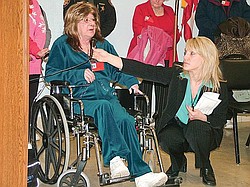
FINALLY OVER: Mary Jane Heiss, left, mother of murder victim Tami Engstrom, discusses the execution of Kenneth Biros at the Southern Ohio Correctional Facility in Lucasville as prisons spokeswoman Julie Walburn holds the microphone.
By Marc Kovac
The execution of Kenneth Biros brings closure to Tami Engstrom’s family.
LUCASVILLE —Con-victed Trumbull County murderer Kenneth Biros apologized and thanked his family and friends for their support and prayers before being executed at the Southern Ohio Correctional Facility in Lucasville.
But Biros did not look at the family members of the woman he murdered in 1991 as he lay dying Tuesday morning in the execution chamber.
“I’m sorry from the bottom of my heart,” he said shortly before the lethal injection was administered and he was pronounced dead. He added, “Now I’m paroled to my father in heaven. I get to spend the holidays with my Lord and savior Jesus Christ. Peace to you all. Amen.”
Cheri Heiss, sister of the murder victim, said the apology was not sincere.
“He didn’t really look me or anyone in the eye when he said that,” she said. “And he said it so fast. It was definitely not a meaningful statement by any means. There was nothing behind that. ... It did not come from the heart. The only reason Kenny Biros is sorry is because he got caught, and believe me, this is not the first time he’s done this.”
Biros, 51, was convicted in the February 1991 murder of Tami Engstrom, a 22-year-old woman he offered to drive home from a Masury bar. The victim was murdered and dismembered, with parts of her body scattered in two Pennsylvania counties.
This was Biros’ second trip to the Death House. He spent the night at the Lucasville prison in March 2007, but last-minute court action stayed his execution at that time.
Federal courts denied his request for further delays, saying the state’s new single-drug lethal-injection protocol and backup plan in case veins were not accessible made moot his earlier legal arguments concerning the constitutionality of Ohio’s lethal-injection process.
Biros was transported early Monday from Death Row at the Ohio State Penitentiary in Youngstown to the Southern Ohio Correctional Facility and spent much of the day resting on the bed in his cell, sometimes asleep, sometimes with his eyes closed.
“He’s appeared to be calm throughout the evening, restful,” said Julie Walburn, spokeswoman for the Ohio Department of Rehabilitation and Correction. “There is some note, during visitation, that the visitation was a little bit emotional. But otherwise, he has been very calm, [execution team members] used the word ‘relaxed’ with me.”
Biros met with spiritual advisers and took communion from about 3 to 4 p.m. He then had contact visits with family members from about 4:40 to about 7:30. Visitors included his mother, sisters, brother, a brother-in-law, friends and spiritual advisers.
Biros was given five meditation CDs for use in his cell by his spiritual advisers, which included a catholic priest and two Buddhists.
After his contact visits, he ate most of his special meal, which included pizza with extra cheese, mushrooms and onions; onion rings; fried mushrooms; Doritos; French onion dip; blueberry ice cream; cherry pie; Dr. Pepper and ketchup.
Biros had vein, medical and mental-health assessments throughout the day and evening. He called his sister a couple of times during the evening, watched television, listened to CDs, read a book and wrote in a tablet.
Biros asked that his cell light be turned off after midnight and lay on his bed listening to CDs. He slept for about three and a half hours, woke up after 6 a.m. and showered.
About 6:30, he began cell-front visits with family and friends, two at a time. He gave CDs, writing materials and other personal belongings to his sister and brother after 7 a.m. He visited with family, spiritual advisers and attorneys until about 9 a.m., including taking communion and praying with his mother and a priest. He drank at least four cups of water during the morning but ate no food from midnight until his death.
Biros’ execution was delayed for about an hour as the inmate sought high-court intervention on his request for a temporary restraining order, questioning the constitutionality of Ohio’s lethal-injection process.
The U.S. Supreme Court declined those efforts just before 10 a.m., allowing the death sentence to proceed about an hour later than originally scheduled.
The execution process started just after 11 a.m., and Biros winced in pain at least eight times as volunteers worked to establish intravenous shunts into his right and left arms.
He was moved into the execution chamber just after 11:30. He looked directly at his attorney and two spiritual advisers and nodded as was strapped to the table. He was allowed to have a white scarf — an apparent Buddhist symbol of purity and happiness — and what appeared to be a couple of picture cards, which were placed on the table with him.
Biros closed his eyes after giving his final statement and mumbled as the drug was being administered. His chest heaved, and he looked to be struggling to breathe about five minutes into the process. Bodily movement stopped after about 10 minutes. He was pronounced dead at 11:47 a.m.
The witness room was mostly quiet during the process. Mary Jane Heiss, mother of the murder victim, sat in a wheelchair breathing with assistance from a medical device. As the curtains were closed, Debi Heiss, Engstrom’s sister, gave a thumbs-up sign to her mother. They clapped after the final time of death was announced, and Cheri Heiss danced in the media briefing room after later speaking to reporters.
Family members of the murder victim also thanked the prosecutors, judges, legal staff, prison staff and others involved in bringing about Tuesday’s execution — a day they said was too long in coming.
“I was very happy,” said Mary Jane Heiss. “This is one of the most happiest days of my life. ... He ruined my family, he ruined our lives.”
“It took 18 years — it was 18 long years,” added Tom Heiss, brother of the murder victim. “He should have been dealt with 17-and-a- half years ago. I’m glad he’s gone. ... It brought closure to our family, but I still think he took the easiest way out there is. He was a coward from Day One. He’s a coward till this day.”
Cheri Heiss said the execution process went smoothly — too smoothly — with no signs of pain or suffering.
“I think he should have went through some kind of pain for what he did,” she said, adding that Biros should have been put to death using the electric chair. “There is nothing painful about it. He went into a sleep very peacefully, and he was gone.”
mkovac@dixcom.com