 43
43

Families find displays of fighter jets, other military aircraft uplifting
Air Show Saturday
 Video
Video
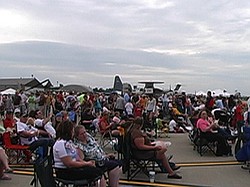
Thunder Over the Valley Air Show at the Youngstown Air Reserve Station Saturday, August 8, 2009.
- Thunder Over the Valley
-
- Vindy Story: Families find displays of fighter jets, other military aircraft uplifting
- Video: Air Show Saturday
- Vindy Story: ‘Race cars in the sky’ delight crowds despite steady rain
- Vindy Story: All systems go at Valley base for today’s air show
- Vindy Story: FIGHTER PLANE || ‘Nose art’ on C-130 has Pavlik leading the way
- VIDEO: The Thunderbirds Arrive
- Vindy Story: Air show survival guide
- Video: Kelly's C-130 Nose Art
- Link: Thunder Over the Valley Web site
- Vindy Story: Valley native to fly in air show
- Panorama: Panorama: Air Show concourse
By Sean Barron
Many model-plane enthusiasts did their part to add color, height and speed to the two-day show.
VIENNA — One of 12-year-old Riqui Stevens’ goals is to join the Air Force, and after stepping inside an F-4 fighter jet, her desire to be in the military took off.
“I hope to learn more about the Air Force and what it takes to be in it,” Riqui said, after having disembarked from the small jet with her parents, Michael and Angela, and 11-year-old brother, Teddy.
That was one of the first things the Mineral Ridge family did after arriving Saturday for the Thunder Over The Valley Air Show and Open House at the Youngstown Air Reserve Station.
The number of buttons in the F-4’s cockpit caught the eye of Teddy, a member of Boy Scout Troop 40 of Girard. His troop helped set up barrels, tables and chairs at the air base before the show, he said.
“I’m impressed,” added Angela, who was an ROTC member during high school. “It’s fascinating; we love all the planes.”
This weekend’s show is the first of its kind for the Mahoning Valley in 23 years, and it should be “a great draw” for people without money for a vacation, Michael Stevens said. The two-day event, which continues today, also will be a boon for the Valley, he predicted.
The F-4 was one of a few dozen Air Force planes on display and available for tours at the show. Another was a KC-135 that left an indelible impression on Mike Litwin of Bazetta and his three children, Megan, 7, Samantha, 11, and Michael, 12.
The main function of a KC-135 is performing refueling operations, so the younger Michael enjoyed seeing the cockpit and lying down in a section of the plane where fuel is loaded, he said.
Also on Megan and Samantha’s to-do list during their visit was seeing the F-16 Fighting Falcons, flown by members of the Air Force Thunderbirds, perform numerous aerial maneuvers.
“I love it,” Megan added, after stepping off the huge plane.
The KC 135 is designed to refuel C-5 and other fighter jets and cargo planes so they safely make it to and from missions overseas and elsewhere, explained Matt Tompkins, a senior reserve airman with the 465th Air Refueling Squadron, based at Tinker Air Force Base near Oklahoma City.
The KC-135 used for demonstrations and tours during the show has flown for more than 50 years. It can carry up to 170,000 pounds of fuel, as well as a three-person crew, Tompkins noted.
It didn’t take long for a long line to form leading to an A-10 War Hog jet, used primarily to assist and protect ground troops.
The plane at the show was built in 1979 and is still used by reserve units, noted Lt. Col. Jim Marks, who’s stationed at Barksdale Air Force Base near Shreveport, La.
The low- to medium-altitude plane is one type being used for combat operations in Afghanistan, and can shoot up to 70 rounds per second, said Marks, a member of the 47th Fighter Squadron.
“People can look inside, and we show the public what they’re paying for, tax-dollar-wise,” he added.
Another plane that drew lots of attention was a C-130, designed to support air and special-forces units. It can carry up to 92 passengers or 64 paratroopers at a time, one official said.
The air show opened with a variety of remote-control planes being flown over the runway, many of which performed stunts and acrobatics simulating those later put on by the F-16s.
Joe Steklachick of Hermitage, Pa., brought a Carden aircraft YAK 54 he had assembled from a kit and was operating a remote device, causing his plane to do a series of turns, rolls and loops.
Steklachick, a member of the Mercer, Pa.-based Nelson RC Flyers club, said his red, white and blue model, made largely from plywood and foam, weighs 37 pounds and has a 17-horsepower engine. It also features a 118-inch wingspan and can travel up to 90 mph, said Steklachick, who has 33 years of experience flying radio-control planes.
“It takes a little bit of talent and practice to stay with it,” he said with a chuckle.
Steklachick said he takes part in about three air shows annually, as well as model-plane and other events. He’s also happy to dispense advice to those who seek him out, Steklachick added.
Narrating the remote-control portion of the air show was Steve Gerish, president of the Night Hawks club in North Jackson.
Roughly 10 such clubs, most based in the Valley, participated in that part, Gerish noted. Among the models represented were war planes, helicopters, sport and aviation types, and turbine-operated planes, he continued.
The turbines are capable of reaching speeds up to 315 mph, but were not permitted to go faster than 200 mph during the show, he continued.
Most model-plane clubs follow rules set forth by the Academy of Model Aeronautics of Muncie, Ind. The AMA works with the Federal Aviation Administration and Federal Communications Commission to spell out rules regarding the use of airspace and radios, Gerish said.