 43
43

MetroParks plow toward wetlands-restoration goal
 Photo
Photo
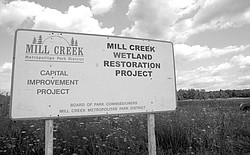
This 48-acre site owned by the Mill Creek MetroParks system is being restored to its original wetland environment.
 Photo
Photo
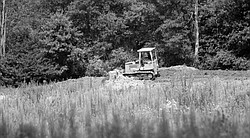
RESTORATION: A bulldozer moves dirt on the 48-acre site owned by the Mill Creek MetroParks system. The site, which used to be a sod farm, is being restored to its original wetland environment.
By Jon Moffett
The project is expected to be completed by mid-October.
CANFIELD — Dirt is being moved around along Western Reserve Road, but the construction workers are “undeveloping” land to bring it back to its original condition as a thriving ecosystem.
The Mill Creek MetroParks system is restoring 48 acres of farmland, formerly Orvets Sod Farm, to its original wetland environment. The project began early last month and should be completed by mid-October.
“There are two goals with this project,” said Justin Rogers, project manager and landscape architect for the park system. “The restorations itself will provide additional habitat for native plant and animal species and will also improve the water quality in the surrounding environment.”
The second goal, he said, is for the wetland area to act as “a buffer and protection” for a Category 3 wetland complex adjacent to the site.
The Ohio Environmental Protection Agency defines a wetland as “areas of land where the water table is at, near or above the land surface long enough each year to result in the formation of characteristically wet soil types, and support the growth of water-dependent vegetation.”
The Ohio EPA classifies Category 3 wetlands as showing “superior wetland functions.”
The park system purchased 303 acres to expand in 2005 and 2006. That land was purchased for $2.6 million through grants and donations.
The MetroParks system was awarded about $2.5 million in grant money through the Ohio EPA’s Water Resource Restoration Sponsor Program. The money includes provisions for a five-year agreement for monitoring by the park system. The MetroParks hope to include trails and other amenities for the public, but those wouldn’t be until further down the road, Rogers said.
The project was awarded to Brookside Construction Services Inc. of Medina. It is working with Envirotech Construction of Sommerset, Ohio, and Eco-Design and Engineering of Plain City, Ohio.
The effort involves tackling non-native species, grading and digging out portions of the land to naturally retain moisture, and then planting natural grasses and other plants.
The project required a sponsor, Rogers said, and the park system was able to find a suitor locally.
“We had to find a sponsor for the grant,” he said. “The village of Lordstown had a sanitary improvement project ... and if they were to partner with an organization that had a water quality improvement project, something that improved or restored a natural habitat, they would be able to get a reduced loan for their project.”
Ron Barnhart, Lordstown’s planning and zoning administrator, said the village is undergoing a $10 million project to replace the septic systems on its East Side, or about one-third of the village.
“The benefit is more to help Mill Creek Park,” he said. “It’s a big help to us, but the main reason we got involved was to help Mill Creek Park obtain the money. But it certainly didn’t hurt us at all.”
The partnership with the MetroParks brought the 30-year loan’s interest down 2.55 percent, Barnhart said.
Rogers agreed with Barnhart on the importance of the project.
“I think public opinion of wetlands is wrong. A lot of people view them as swamp areas that are useless. With this project, because of its history, recent uses and now restoration, we’ll be able to identify the function and necessary uses of such a habitat,” he said. “Hopefully that’s one thing we can convey to the public is these are not wasted spaces. They do have functions and environmental purposes, and they benefit the community.”
Rogers said he has a personal sense of satisfaction for the project, especially since the park system outbid a developer with plans for the land.
“There was a proposed development for this parcel, and you can develop intelligently,” he said, “but this is a prime area in the floodplain of Mill Creek that needs to be protected. Having the ability to do so and see it revert to what is was pre-development is very gratifying.”
Linda Kostka, MetroParks public relations director, said, “It’s important to preserve some of the last parts of wild space in Mahoning County because there is a lot more development than there used to be. And this is a great learning opportunity for the public as well.”
jmoffett@vindy.com