 43
43

Mahoning juvenile-crime summit stresses teamwork value
High expectations produce high achievement among children, a congressman says.
 Photo
Photo
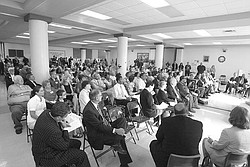
ATTENTIVE AUDIENCE: More than 200 people gather for the Mahoning County Juvenile Court Summit at the Mahoning County High School on Hudson Avenue in Youngstown. In the crowd Tuesday were two congressmen, city, county and state officials, police brass and educational, child advocacy and social service agency leaders.
YOUNGSTOWN — Ensuring the success of the Mahoning Valley’s youths and further reducing juvenile crime will require a coordinated approach by officials from all levels of government, speakers said at the first Mahoning County Juvenile Court crime summit.
“We have to make sure that money does come here from Washington and the state” to address the needs of local youths, said Anthony T. Traficanti, chairman of the Mahoning County commissioners. “Local governments are squeezed. ... We still have a low tax base and, unfortunately, a high crime rate.”
Traficanti praised the summit’s organizer, Judge Theresa Dellick of the county’s juvenile court, for attracting “more grant money than anybody I know” to her court and the programs it operates.
“She gives our youth of our community a second chance and hope for a better life and a better future,” Traficanti said.
The summit, which took place Tuesday at Mahoning County High School on Hudson Avenue, drew more than 200 people, including U.S. Reps. Tim Ryan and Charlie Wilson, and numerous city, county and state officials, police brass, and educational, child-advocacy and social-service-agency leaders.
“We have to see all levels of government coming together to be able to help our kids in this community,” said Wilson, of St. Clairsville, D-6th.
Ryan, of Niles, D-17th, said it’s necessary to break down the isolation mentality that’s present in some segments of society. “We need to regain that culture that we are all in this together,” he said.
To help reduce crime in Youngstown, Ryan pointed to federal money the city has obtained for demolition of dilapidated structures, for technology to help police identify the source of gunfire, and for the Police Athletic League, which fosters positive relationships between police and community youths.
Ryan said the House has passed a bill containing $900,000 in federal funds to be shared by the Youngstown, Niles and Warren schools for a social-and-emotional-learning program, which is aimed at regulating students’ emotions to enable them to maximize their ability to concentrate on learning.
The program has been tested among 300,000 children and improved their academic achievement test scores by an average of 11 percentile points, Ryan said. “That closes the achievement gap,” he added.
“A lot of our schools are lagging behind. We need the most cutting-edge innovative programs that are happening around the country here in the Valley in our local schools,” Ryan said.
It’s also important to set high expectations for children, including completing college, because high expectations lead to high levels of achievement, he said.
Tom Stickrath, director of the Ohio Department of Youth Services, praised the county’s juvenile court as a “go-to court” with an innovative attitude. “She’s always one of those first people I call if we’re trying to float a new idea,” he said of Judge Dellick.
The local juvenile court piloted an assessment tool for determining which youthful offenders should stay home and be served by local programs and which ones need to go to a DYS detention center. Stickrath said that tool will be used statewide by the end of the year.
“We’re now going to speak one common language,” as opposed to having 77 different types of assessment tools statewide, Stickrath said.
Judge Dellick presented statistics showing significant declines in major categories of juvenile crime in recent years in the county.
She attributed those declines to her court’s making the right decisions on which offenders stay home and which ones go to DYS, the effectiveness of local juvenile-court programs, and the effectiveness of collaboration between her court and various local agencies that serve children and teenagers.
“Our goal is to rehabilitate. Our goal is to decrease the amount of crime going into the adult system,” the judge said.
milliken@vindy.com
Mahoning County Juvenile court | 2008 detention admissions:
Youngstown: 465; 63 percent
Boardman: 57; 7.74 percent
Struthers: 49; 6.6 percent
Campbell and Coitsville: 39; 5.3 percent
Lake Milton: 13; 1.77 percent
Poland: 12; 1.63 percent
Sebring and Goshen Township: 12; 1.63 percent
All other Mahoning County communities: less than 1 percent each.
Source: Judge Theresa Dellick, of Mahoning County Juvenile Court