 43
43

‘Fringe’ creators use past sci-fi shows for inspiration
Associated Press
 Photo
Photo
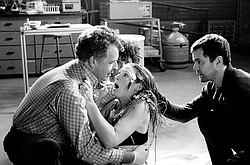
SCI-FI SERIES: John Nobles, left, Ann Torv, foreground, Jasika Nicole and Joshua Jackson appear in a scene from "Fringe," Premiering Sept. 9 at 8 p.m. on FOX.
By LUAINE LEE
The show premiers on Fox tonight.
BEVERLY HILLS — Ever wonder what inspires the creators of some of TV’s top thrillers? Old TV thrillers, it turns out. Take the case of J.J. Abrams, Alex Kurtzman and Roberto Orci — the guys who created “Lost,” “Alias” and the coming “Star Trek” movie.
They’re back this season with the hotly awaited sci-fi adventure, “Fringe,” premiering on Fox tonight and slipping into its regular time period Sept. 16.
“We sat in a room and just kind of listed off our shows. And for me, I always wanted to do kind of a real geniuses solving problems [show],” Orci said, who’s been writing with Kurtzman since high school.
“And Alex was a huge fan of ‘Twin Peaks’ ... ‘Fringe’ is kind of a cross of those three things, and then obviously ‘X-Files’ is an inspiration as well, but that’s not where we started.”
It started with the question about what they would like to see on TV, Abrams said. “I thought we would get slammed sort of doing the David Cronenberg, ‘Altered States’ stuff because for me that was always something I was obsessed with when I was growing up. ... The Michael Crichton stuff, which for me started with ‘Westworld,’ or even, Robin Cook stuff like ‘Coma’ and certainly all the Cronenberg work, which was that weird place where medicine and science meet real life,” Abrams said.
“So that was when Alex and Bob and I started talking. It was: ‘How can we do a show that lives in that universe?’ And certainly ‘The Twilight Zone,’ ‘X-Files,’ ‘Night Stalker,’ those were shows that I loved.”
“Fringe,” which begins with a two-hour premiere, is about a mysterious syndrome that kills everyone on an international flight to Boston and infects one of the investigators. Part medical puzzle, part sci-fi fantasy, it combines both worlds, blending the practical with the practically impossible.
“... In much the way that an episode of ‘ER’ would start with a body or somebody to save, our cases-of-the-week are pretty much something happened in the world,” said executive producer Jeff Pinkner, who steered “Alias” through its final season.
“The standard we’re trying to hold ourselves up to is, when the first commercial hits, ideally people are calling their friends and saying, ‘You can’t believe what just happened on Fox. You have to change the channel and check out this show.’ And ideally that same event which grabs the audience, grabs our characters’ attention, and simultaneously we’re very much telling the stories of these people, which will also have sort of a story-of-the-week kind of shape,” he continued.
Unlike “Lost” or “Heroes,” audiences don’t have to catch every single episode to manage the convoluted plotlines.