 43
43

Witness to Gustav: ‘This was nothing’
Associated Press
 Photo
Photo
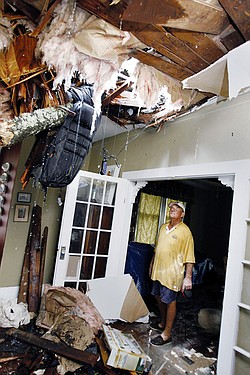
STORM DAMAGE: Richard Bezet looks over damage to the living room of his Baton Rouge, La., home after a tree fell through the roof because of winds from Hurricane Gustav.
The weakened storm only sideswiped New Orleans, but it left 1 million without power.
NEW ORLEANS (AP) — A weaker-than-expected Hurricane Gustav swirled into the fishing villages and oil-and-gas towns of Louisiana’s Cajun country Monday, delivering only a glancing blow to New Orleans that did little more than send water sloshing harmlessly over its rebuilt floodwalls.
Gustav weakened to a tropical storm as it crossed central Louisiana last night. The National Hurricane Center said the storm’s maximum sustained winds dropped to about 60 mph. At 11 p.m. Monday, the storm was about 20 miles southwest of Alexandria, and it was moving at about 13 mph.
Gustav was the first test of New Orleans’ new and improved levees, which are still being rebuilt three years after Hurricane Katrina. And it was a powerful demonstration of how federal, state and local officials learned some of the painful lessons of the catastrophic 2005 storm that killed 1,600 people.
“They made a much bigger deal out of it, bigger than it needed to be,” 31-year-old security worker Gabriel Knight said in New Orleans’ nearly empty French Quarter. “I was here with Katrina. That was a nightmare. This was nothing.”
That did not mean the state came through the storm unscathed. A levee in the southeastern part of Louisiana was in danger of collapse, and officials scrambled to fortify it. Roofs were torn from homes, trees toppled and roads flooded. A ferry sunk. More than 1 million homes were without power. And the extent of any damage to the oil and gas industry was unclear.
But the biggest fear — that the levees surrounding the saucer-shaped city of New Orleans would break — hadn’t been realized.
Wind-driven water sloshed over the top of the Industrial Canal’s floodwall — the same structure that broke with disastrous consequences during Katrina — and several Ninth Ward streets close by were flooded with ankle- to knee-deep water. Still, city officials and the Army Corps of Engineers expressed confidence the levees would hold.
Maj. Tim Kurgan, a Corps spokesman, said late in the day: “We don’t anticipate any problems, but we’re still watching this storm because it has not passed the area yet.”
Gustav blew ashore around 9:30 a.m. near Cocodrie, a low-lying community 72 miles southwest of New Orleans.
Forecasters had feared a catastrophic Category 4 storm on the 1-to-5 scale, but Gustav weakened as it drew close to land, coming ashore as a Category 2 with 110 mph winds. It quickly dropped to a Category 1 as it steamed inland toward Texas.
Authorities reported seven deaths related to the storm, all traffic deaths, including four people killed in Georgia when their car struck a tree. Before arriving in the U.S., Gustav was blamed for at least 94 deaths in the Caribbean.
In the days before the storm struck, nearly 2 million people fled coastal Louisiana under a mandatory evacuation order — a stark contrast from Katrina. Those evacuated included tens of thousands of poor, elderly and sick people who were put on buses and trains and taken to shelters and hotel rooms in several surrounding states.
It could be days until the full extent of the damage is known, especially in the fishing villages and oil-and-gas towns of bayou country, where rapid erosion in recent decades has destroyed swamps and robbed the area of a natural buffer against storms.
Keith Cologne of Chauvin, not far from Cocodrie, looked dejected after talking by telephone to a friend who didn’t evacuate. “They said it’s bad, real bad. There are roofs lying all over,” said Cologne, staying at a hotel in Orange Beach, Ala.
One community in southeastern Louisiana feared its levee wouldn’t hold. The parish president called a local TV station to plea with any residents still there to flee, and crews moved sandbags and moving equipment into place to reinforce the levee and its metal floodgate. Though it was stressed, it didn’t break.
It could be a day or more before oil and natural gas companies can assess the damage to their drilling and refining installations. To the east of the city, state officials were unable to reach anyone at Port Fourchon, a vital energy industry hub where huge amounts of oil and gas are piped inland to refineries.
The Gulf of Mexico accounts for about 25 percent of domestic oil production and 15 percent of natural gas output. Damage to those installations could cause gasoline prices at the pump to spike.
, although oil prices declined Monday.
While Katrina smashed the Gulf Coast with an epic storm surge that topped 27 feet, the surge this time in New Orleans reached 12 feet, near the top of the Industrial Canal, on the eastern side of the city.