 43
43

Gustav should slam coast today
Associated Press
 Photo
Photo
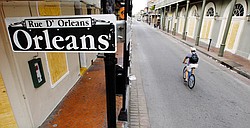
LONELY: A bicyclist rides through the French Quarter of New Orleans. Most of the city has been evacuated.
The hurricane forced the evacuation of 2 million Americans and is upstaging today’s GOP National Convention.
CHICAGO TRIBUNE
NEW ORLEANS — With Hurricane Gustav speeding toward New Orleans from one direction, frightened area residents jammed highways out of town in the other on Sunday, fleeing ahead of a powerful storm that officials said could overwhelm the fragile levee system still not completely repaired after Hurricane Katrina’s damage three years ago.
As heavy rain began falling in the city Sunday night, National Weather Service forecasters predicted that the hurricane would make landfall midday Monday near Morgan City, La., 70 miles west of New Orleans. But powerful winds were expected to pummel the city well before then.
Gustav was expected to crash into land as a dangerous Category 3 storm, somewhat diminished from earlier predictions but still packing winds over 115 miles per hour and capable of kicking up 14-foot storm surges and dumping up to 20 inches of rain.
At 11 p.m. Sunday, the National Hurricane Center said Gustav was centered about 220 miles southeast of New Orleans and was moving northwest near 16 mph. It had top sustained winds of 115 mph, and was likely to stay a Category 3 storm when it made landfall west of New Orleans
The forecast meant that New Orleans would lie on the hurricane’s eastern — and most dangerous — side, where the counter-clockwise forward motion of the storm could test unfinished or aging levees, bursting some and overtopping others.
Levee failures caused by Katrina flooded 80 percent of New Orleans, leading to the deaths of more than 1,800 people and the loss of at least 100,000 homes.
But with the precise landfall location still uncertain, as well as the chance of a last-minute turn to the left or right, the weather service issued hurricane warnings stretching more than 500 miles from High Island, Texas, to the Alabama-Florida state line. Authorities estimated that nearly 2 million residents of coastal Texas, Louisiana, Mississippi and Alabama were clogging roadways leading inland throughout Sunday.
The rest of the nation braced for the potential economic impacts of the hurricane, which forced the shutdown of most offshore drilling rigs in the Gulf of Mexico and many refineries along the Gulf coast.
Analysts said about 15 percent of the nation’s refining capacity had been shut off, and they warned that a prolonged disruption could cause gasoline price spikes of 20 cents per gallon or more.
In New Orleans, although a handful of stragglers vowed to stay — a few dozen scantily-clad participants went ahead with an annual gay parade in the French Quarter — every neighborhood of the city of 310,000 looked like a ghost town in advance of Gustav’s arrival.
For the first time in the state’s history, Louisiana Gov. Bobby Jindal opened all lanes of Interstate highways in both western and eastern Louisiana to “contraflow,” or outgoing traffic, to facilitate the mass evacuations. State police officials said they believed more than 95 percent of coastal Louisiana residents had fled inland, marking a record-setting evacuation.
But even before the heavy winds began to howl, Gustav was reordering the nation’s political priorities as the current president and the two men who are vying to succeed him each took proactive steps to get involved.
Sen. John McCain, due to be officially nominated as the Republican presidential candidate at his party’s national convention that begins tonight in St. Paul, announced that he was abbreviating the convention’s speeches and celebrations in deference to the threat posed by the hurricane. McCain spent part of Sunday in Mississippi, meeting with state leaders and disaster preparedness officials.
Meanwhile, President George W.. Bush canceled his scheduled Monday night speech at the convention and instead planned a trip to Texas to monitor the region’s hurricane response-a sharp contrast to what critics called his administration’s detached and sluggish response to Hurricane Katrina.
“The message to the people of the Gulf Coast is, this storm is dangerous,” Bush said after a briefing on Hurricane Gustav’s path and power. “There’s a real possibility of flooding, storm surge, and high winds. ... Do not put yourself in harm’s way, or make rescue workers take unnecessary risks.”
Sen. Barack Obama, the Democratic nominee, said his campaign would tap into its Internet fundraising apparatus to recruit volunteers and solicit donations for storm relief.
In New Orleans, city officials said they had evacuated more than 18,000 infirm or impoverished residents who needed help to leave, giving them confidence that there would be no repeat of the human disaster that followed Hurricane Katrina, when tens of thousands of residents were left stranded.
Officials backed away from earlier estimates that up to 30,000 residents might need help to evacuate and said they felt they had reached everyone who required assistance. But some activists expressed fears that mentally troubled residents might have been left behind.
because no door-to-door notification effort was made. By late Sunday afternoon, with a dusk-to-dawn curfew set to take effect, the only signs of life in the city were some 3,000 police and National Guard troops patrolling against looters.
— a show of force intended to prevent a reprise of the lawlessness that descended upon the stricken city after Katrina.
“Anybody who is caught looting will go directly to (the state prison at) Angola — directly to the big house, in general population,” Mayor Ray Nagin warned. “And God bless you when you get there.”
(EDITORS: STORY CAN END HERE)
At the city’s central bus station Sunday morning, officials loaded the last citizens needing help to evacuate onto outbound buses headed for northern Louisiana. Some stepped into line carrying just a single possession: A battered green suitcase, a plastic bag holding a single shirt, a parrot in a wire cage.
“We don’t care where we go. We just want to get out,” said David Henderson, 50.
But on historic St. Charles Avenue in the Uptown section of the city, Elliott Thomas leaned over a fence outside his cousin’s boarded-up house and gazed in wonder at the abandoned neighborhood before him.
Thomas, 63, said he had decided to stay and ride out the storm to help his cousin care for a 90-year-old uncle who was too infirm to travel.
“I understand why people are leaving — this city takes on water when hurricanes come,” Thomas said. “But we’re on high ground here. We didn’t flood during Katrina. We’re just praying and hoping this one doesn’t come in as bad as they think it could be.”
———
(Chicago Tribune staff reporters James Janega in New Orleans and James Oliphant in Ohio and Tribune news services contributed to this report.)
———
(c) 2008, Chicago Tribune.
Visit the Chicago Tribune on the Internet at http://www.chicagotribune.com/
Distributed by McClatchy-Tribune Information Services.
—————
PHOTOS (from MCT Photo Service, 202-383-6099): wea-gustav
GRAPHICS (from MCT Graphics, 202-383-6064): wea-gustav