 43
43

Area in Ridge will be tested for mine subsidence by ODNR
 Photo
Photo
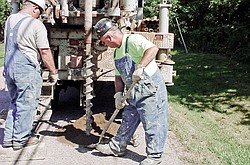
DRILLING DEEP: From left, Dennis Bickford, exploratory drill operator, and Jerry Watts, soils resource specialist, survey and drill on land in Mineral Ridge to look for mines. The Ohio Department of Natural Resources Division of Mineral Resources Management crew drilled on Edwards and Liberty streets.
 Photo
Photo
Weathersfield mines
By Mary Smith
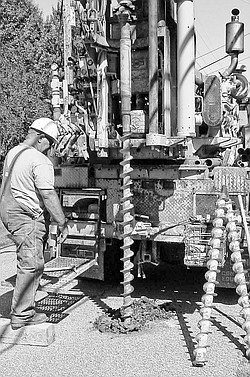
Drilling has taken place on Edwards and Liberty streets.
MINERAL RIDGE — A team that has worked in Weathersfield Township on a mine stabilization project for the past month plans to start another project in the township over the next several weeks.
The Ohio Department of Natural Resources Division of Mineral Resources Management will send a crew to the Oakview Drive area to measure subsidence.
In geology and surveying, “subsidence” is the motion of a surface, usually, the earth’s surface, as it shifts downward.
Derek Collins, chief geologist of the ODNR, Division of Mineral Resources Management, said the department’s mine subsidence crews have been working in Mineral Ridge during late August and in September on Edwards Street in response to several complaints from residents about sagging in their yards, depressions or open holes.
He said the bulk of complaints has come in from homeowners, and Edwards Street is known by the department as having a history of old coal mines the department has investigated.
Surveying on the street was done two weeks ago after drilling was complete, and about 40 holes were drilled to check for mines.
Three holes also were drilled on an open field close to a home at 3900 Edwards, where resident Marvin McBride lives.
The ODNR crew also drilled on Liberty Street at a single property from a complaint from a homeowner. The information will then be turned in on the project and a review process starts.
Collins said he will write a draft report of his recommendations in about three to four weeks on the Edwards Street project.
He said there have been five locations on Edwards where actual mine stabilization work has been done in the past.
Jim Gue, project officer of the ODNR’s Division of Mineral Resources Management office in Salem, said results of the study of Edwards Street showed that there was a mine at the north end of the street, which has already collapsed. There are still two openings to the mine.
On the south end of Edwards there was no coal left. Gue said that what will be done next will depend on Collins’ report.
Gue said some additional funding was appropriated by Congress last year and each state is receiving the extra funds based on a federal formula. The money comes through the U.S. Department of the Interior through the Office of Surface Mining.
With the added money available, ODNR is checking statewide on problem areas to make sure they do not present any added concerns.
He said Edwards Street is an area where the department has had a problem for a long time. He said they drilled there in 1985, and the department “wanted to get a better feel for the status on Edwards.”
Collins said problems on Edwards Street have been serious in the past, with some open areas where mining has occurred past the mines, some mines that already have collapsed, and some found that had no coal at all.
He said there are not any maps of the region that reflect the actual presence or lack of mine shafts, because some mines, called “peddler” mines, were dug by private individuals for mining coal for their own use or to sell.
Known mines in the Edwards Street region include: Sharon No. 1, closed in 1889; and mines owned by the Andrews Brothers, closed in 1883; Osborne Coal Co., closed in 1883; and Todd, Wells & Co., closed in 1889.
The department also relies on accounts of people who grew up where mines are located and their parents worked in mines, or from “old timers” who actually worked in a mine.
Homeowners on Edwards were notified that the department would be coming in to do exploratory drilling, “to explore the cause of subsidence activity related to past underground coal mining operations.”
Although the mine subsidence team is not set up as an emergency response team, it can show up at a site in 72 hours, which is how long it takes to get clearance to drill from the Ohio Underground Protection Services.
If the department decides that mine subsidence work has to be done at a site, the work would be bid out to a public company, said Collins, and Jerry Watts, soil resources specialist who was surveying on Edwards Street last week after the drilling was completed.
Collins said a high number or frequency of calls from residents over time on a particular street will spark an investigation by an ODNR team on possible mine problems.
“I drill wherever I have a complaint,” Collins said. His department is federally funded under the Surface Mining Reclamation and Conservation Act, first passed under President Jimmy Carter in 1977.
Ohio began investigating mine-related problems in the state in the 1980s, and he has been with the department since 1986.
The mining act is targeted at states that have coal mines, and although it is federally funded, the state has authority to implement and perform mine subsidence work using those federal funds.
Though ODNR may be better known for granting you a fishing or hunting license, or running some of the state’s many parks and lakes, Mineral Resources Management also is a division of the department.
Township administrator David Pugh said the team contacted the township and received permission to drill on township roads or road rights of way.