 43
43

Longing for the ride
WRTA Rider
 Video
Video
 Photo
Photo
Louise Anderson
By KATIE SEMINARA
WRTA users make a case for tax levy
‘Without a bus system, that is one more nail in the coffin of our community,’ an Austintown resident said.
YOUNGSTOWN — Jim Donnan values his independence.
The Austintown resident is blind, and the Western Reserve Transit Authority bus system is his only method of independent transportation.
“I want to be independent, be a productive member of society, and public transit is an important part of me being able to do that,” he said. “I don’t want to live off the community.”
Donnan, 58, fears he will not be able to work if WRTA continues to cut service. If the proposed levy of a 0.25 percent sales tax fails in November, more routes and frequencies on routes could be eliminated, said James Ferraro, WRTA executive director.
“A lot of people have been hurt [by loss of service] and hopefully for them, we’ll be able to turn things around,” said Ferraro.
Ferraro noted the WRTA has already cut 60 percent of overall services in the past year.
Donnan is one of those riders who has been affected by the cuts. Relying on family and friends to get to the doctors, dentist and local stores is now more of a regular occurrence.
If more services are canceled, Donnan fears that he won’t be able to teach at Youngstown State University, where he is a limited service instructor of telecommunications. He would also unwillingly neglect other social activities such as Lions Club.
Donnan questions how narrowing bus services will make the Valley a better place to live.
“If we are left without a bus system, that is one more nail in the coffin of our community,” he said.
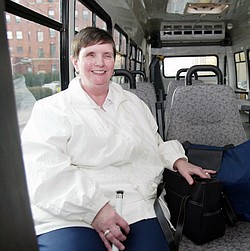
Louise Anderson, 59, of Youngstown is also blind and depends on WRTA to take her to work five days a week.
“I don’t even want to think about the buses not being here,” said Anderson, who has been riding WRTA buses since 1977.
Anderson pays $50 a month for a bus pass that she uses to get to her job at the Catholic Diocese of Youngstown, stores, doctors appointments and her mother’s house.
“Fifty dollars a month might sound like a lot of money, but when you ride five days a week, it isn’t anything,” said Anderson.
The buses are dependable, Anderson said, and some of her colleagues spend upward of $80 a week on gas.
“I just urge people to think before they vote. Think of those who truly need it,” said Anderson, referring to those who would be home bound with the loss of WRTA buses.
Disabled people aren’t the only ones concerned about the WRTA cuts. Many elderly people and those without cars depend on the WRTA.
Margaret Agoney handed in her bingo cards as a result of canceled night and weekend service.
The 84-year-old misses going to bingo on weeknights and Mass on Saturday evenings.
“I don’t drive, don’t have a car and I depend on the bus,” said Agoney, of Youngstown.
Not only does Agoney have to miss out on social events, she also quit her job after certain routes were eliminated.
Now the bus only takes her to medical appointments. To get anywhere else, Agoney must rely on her sister, something she calls a “hardship.”
“There are people everywhere that depend on the service,” she said.
Hannah Woodroofe uses her feet and a bicycle to get around as much as possible, but the bus is her only other alternative method of transportation.
Woodroofe, 27, of Youngstown, is a graduate student at the University of Chicago who is in the Valley working on her Ph.D. in anthropology.
“Last winter, I rode the bus nearly every day, usually a few times a day. That’s excluding weekends when the bus doesn’t run,” she said.
After completing her research, Woodroofe would consider living in Youngstown for a while, but she is waiting for the outcome of the WRTA levy.
“If service stops or becomes very limited, I’ll probably move,” said Woodroofe.
Moving to a place with quality public transportation would be more beneficial than buying a car, she said.
“I’d like people to know that Youngstown’s buses are full of people who ride them because they choose to,” said Woodroofe.
“It’s just as important, however, to remember that they also serve those that really do not have another viable alternative for transportation in the Valley.”
SEE ALSO: Levy details.