 43
43

Ritual represents cleansing
 Photo
Photo
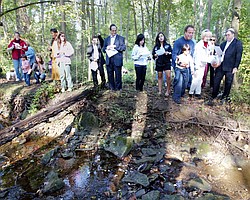
Re-enacting Tashlich on Rosh Hashana, Rabbi Joseph Schonberger and members and friends of Temple El Emeth tossed bread into a stream flowing through a ravine near the rabbi’s home Tuesday afternoon.
Water has a purifying nature, the rabbi said, and relates to the world and our environment.
LIBERTY — The ancient ritual of Tashlich, tossing bread crumbs into a stream of water with fish, symbolizes casting away sins and being cleansed by the water.
Re-enacting Tashlich on Rosh Hashana, Rabbi Joseph Schonberger and members and friends of Temple El Emeth tossed bread into a stream flowing through a ravine near the rabbi’s home Tuesday afternoon.
“The ritual represents cleaning up and discarding the negative that we have accumulated throughout the year, by design or unknowingly, with or without intention,” Rabbi Schonberger said. “It’s cleaning up our act,” he said, putting it in contemporary terms.
The ritual by Jews dates to the Middle Ages. Rabbi Schonberger said he has conducted the Tashlich since he came to Temple El Emeth, 3970 Logan Way, in 1997.
Rabbi Schonberger said the Book of Micah, Chapter 7, has an indirect reference to the idea of casting bread on the water. In Ecclesiastes 11:1 is the verse, “Cast thy bread upon the waters: for thou shalt find it after many days.” A reference in the Torah reads, “You will cast all their sins into the depths of the sea.”
Jews throughout the world observed the eve of Rosh Hashana at sundown Monday. Rosh Hashana marks the beginning of the Jewish new year, 5769. This time is one of reflection and repentance, concluding with Yom Kippur, the Day of Atonement, Oct. 9. Water has a purifying nature, Rabbi Schonberger said, and relates to the world and our environment. The bread crumbs represent our souls, he said, which are cleansed by the water. The bread crumbs also represent our sins, which are cast away.
Rabbi Schonberger also equated the bread as food for the fish and how the idea of this ritual cleansing was nourishing to spiritual life. “The ritual symbolizes the reality of making improvements in our lives ... acknowledging the positive and negative. Working toward a balance reflects our human existence.”
He also pointed out that water represents the Torah and just as fish can’t live without water, Jews can’t live without the sacred writings of Judaism.
Rabbi Schonberger said he also thought of the bread crumbs “as the imperfections we want to make right ... the crumbs become part of the environment ... and we’re in harmony with the universe.”
The rabbi led the group of about 20 and three pet dogs to the stream in a ravine by his home. There he said the traditional Tashlich prayer, which in part, reads, “Who is like you, God, who removes iniquity and overlooks transgressions of the remainder of His inheritance. He doesn’t remain angry forever because He desires kindness. He will return and He will be merciful to us, and He will conquer our iniquities, and He will cast them into the depths of the seas.”
Leonard Fisher, his daughter Leigh Jaffer and her sons, Jaden, 4, and Jace, 3, were among those participating. Fisher belongs to Temple El Emeth.
“I like the idea of sins flowing away from me and I’m hoping for a good new year,” Fisher said.
Fisher, who is originally from Brooklyn, N.Y., said he remembers going to a park or the ocean to perform the ritual. “The problem with society today is that it’s getting away from traditions,” he said. “I think it’s important to keep them alive. They bring the family together.”
He said that when he was young, he just had to walk out of his house to celebrate Jewish holidays and be with members of his extended family. “It’s important we get together for the holiday even though we’re dispersed in the country.”
Jaffer said she has participated in this ritual with her father for years. She said she grew up in a Jewish-Christian household and was exposed to tenets and holidays of both faiths, providing a rich and diverse background. “I try to explain everything to my sons,” she said. Jaffer said her children are growing up in a two-faith household of Judaism and Islam.
Deborah Charity, a neighbor of Rabbi Schonberger’s, said she listened to a speaker who talked about the Jewish holidays at the recent Pentecost in Perspective International conference sponsored by Bishop Norman Wagner of Calvary Ministries International, where she attends. “I had it in my spirit to attend,” she said of the ritual. “I went on the Internet to learn about the observances.”
Bruce Willner, a Temple El Emeth member, said he has participated in the Tashlich ritual for 15 years. “I like the idea of casting away my mistakes and starting fresh. There is a realization of wanting to do better and having a clean slate.”
Terry Pugh of Brookfield said he has been visiting the temple and learning about Judaism. “I liked the symbolism of a new beginning,” he said of the Tashlich ritual.
Rabbi Schonberger said the ritual often involves a group though it was intended for individuals. His son, David, recalled that when the family lived in Bangor, Maine, many in the community, Jews and non-Jews, participated in Tashlich. “It showed mutual support and brought people together,” his father said.
linonis@vindy.com