 43
43

Counties spread salt wisely
 Photo
Photo
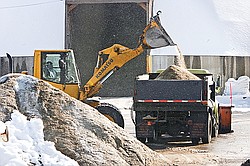
Salt and Sand - Youngstown Street Dept workers load another truck with salt and sand mixture as snow hits the Mahoning Valley
The recent snow became a test run for salt and grit mixtures.
SALEM — State, county and local officials are trying to deal with huge increases in the cost of road salt by trying to use less of it on winter roadways.
Salem, for example, is using 100 percent salt, but only where it’s needed.
Steve Andres, Salem’s director of Public Service and Safety, said his workers responded to Tuesday’s snow by putting salt on curves, hills, and any other place that needed it.
“We’re not spreading it around,” he said.
Last year, Salem paid $38.19 a ton for salt. The new quote from ODOT was $70.55 a ton.
Andres’ department isn’t mixing grit with the salt to stretch the city’s budget. Pure salt is the most effective, he said.
“We’re asking people to be a little more cautious in their driving habits until we see what kind of winter we’re going to get,” he said.
Salt prices shot upward this winter after last year’s long winter and problems with salt production.
Gary Phillips, the village administrator in hilly Leetonia, said he can buy only 100 tons of salt this year for the price he paid for 200 tons last year.
The village is using more ash or grit than salt.
The village normally uses three parts of grit — pea-type gravel — with one part of salt. Now it’s using five to six scoops of grit to one part salt. It may also use cinders, which are rougher, for traction.
Becky McCarty, an ODOT spokeswoman, said that as part of the state’s “Smart Salt Strategy,” state roads were pre-covered with brine Monday night. That helps melt snow as it lands.
When snow increased, workers were out after midnight using a 50-50 salt-grit mix. McCarty said that mix was wet before it was put down so it would stick to the roads.
“We’re using materials as wisely as possible,” she said.
In Mahoning County, Marilyn Kenner, the chief deputy for the engineer’s office, said it treated intersections, bends and hills with a 50-50 grit-salt mix.
The county’s cost per ton climbed from $37.70 to $70.90.
“No problems have [been] reported,” she said.
In New Castle, Pa., road department clerk Mike DeSalvo said the crews were going “very light on the salt.”
New Castle is also using only salt to avoid grit damage to its sewer system.
The city is using about 700 tons of salt left over from last winter. The bad news, DeSalvo said, is that the city generally uses 5,000 tons of salt a winter.
John Deane, highway superintendent for the Trumbull County Engineer’s office, said it, too, was using a mix of salt, grit and slag on curves and intersections.
The department is also trying to spend more time plowing on major routes to avoid having to come back and plow a second time.
wilkinson@vindy.com