 43
43

Musicians find careers with military performance group
 Photo
Photo
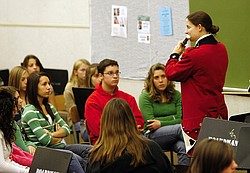
OLD GUARD: Rebecca Davidson plays the fife for band members at Boardman High School. She explained the difference between her fife flute and baroque flute, two of the instruments used in the Army Old Guard Fife & Drum Corps.
By Denise Dick
BOARDMAN — Army Staff Sgt. Rebecca Davidson graduated from Boardman High School in 2001, earned her bachelor’s and master’s degrees in flute performance from Oberlin College and the University of Cincinnati, respectively, and now performs at the White House.
Davidson is a member of the 70-member Army Old Guard Fife and Drum Corps, based in Fort Myer, Va.
“I performed for the president of Ghana in February and for the prime minister of Italy in October,” Davidson said.
Davidson and two other corps members spoke Monday to band students at Boardman High School to inform the young musicians about musical careers in the military. Davidson’s mother, Edie, teaches art at the school.
Corps musicians don’t face deployment. They perform at the White House, for heads of state and in parades including every presidential inauguration since President John F. Kennedy’s in 1961.
The musicians will also be at Liberty High School for a Veterans Day program today.
Members must be invited to audition. Davidson saw an advertisement for the corps while completing her master’s degree, sent in a tape and was invited to audition. She was among two picked to play fife in the corps.
She completed basic training and then began performing.
She plays fife, a woodwind instrument similar to a piccolo, and the baroque flute with the group.
The Old Guard is one of the Army’s four special bands. The others are the U.S. Army Band (Pershing’s Own), the Army Field Band and the Military Academy Band.
“It’s a great opportunity for a musician, and you get to serve your country,” said Master Sgt. Robert Simpson of Rome, N.Y.
Since Davidson joined, she’s been able to travel the country, and her student loans have been paid off.
“There’s an opportunity for every instrument in the Army,” Davidson said.
The presentation persuaded freshmen Tom Moran and Jake Sullivan, both 15 and tenor saxophone players, to consider careers as military musicians.
Jake hadn’t previously thought about joining the military, but learning about the opportunities for musicians has made him consider the career move.
Tom has wanted to pursue a military career since he was 10, but information about the bands allowed him to think about it in a different way.
“It’s something I think I’d like to do,” Tom said.
He has a family history of people in the armed services and joining as a musician would alleviate his mother’s fears that her son might get hurt, Tom said.
“I just want to serve my country,” he said.
Corps members wear the red Colonial-style coats and white wigs similar to those worn by the field musicians of the First American Regiment of 1784 from which the Old Guard originated.
Wearing the opposite color from the infantry soldiers allowed the musicians to stand out. During the American Revolution, musicians were used to send messages on the battlefield.
“The fife, the drum or the bugle could be heard on the battlefield,” Simpson said.