 43
43

Plain eggs become Eastertime gems in traditional art
 Video
Video
Plain eggs become Eastertime gems in traditional art
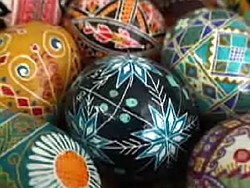
A pysanka is a decorated Ukrainian Easter work of art.
SHARON, Pa. — It’s 2,000 years old, but Ukrainian Easter egg decorating is not a lost art.
You can find it at a little studio next to Billy’s Black and Gold, a bar on Sharpsville Avenue in Sharon.
You can find it March 16 at the 19th annual Egg Festival, which Billy’s will host along with help from St. John’s Ukrainian Orthodox Church.
You can find it at the hands of Carol Novosel, who owns Billy’s and has been decorating the eggs in a Ukrainian tradition that uses wax and dye since she was around 5 years old. The tradition was passed down through the generations in her family.
You can find it at your own hands if you go to the egg festival and try it for yourself.
Novosel’s studio on Sharpsville is full of eggs she’s decorated in preparation for selling them at the festival. Proceeds will benefit the church, which is going to be there, too —selling food that includes pirogi, stuffed cabbage, halushki, chicken Kiev and baked goods.
The money will also go toward helping orphanages and children’s hospitals in Ukraine, which is still feeling the effects of the Chernobyl nuclear reactor disaster from April 1986, Novosel said.
Kids love the festival, and senior citizens enjoy it as well, she said. A community event, it typically draws around 800 people to the bar.
So, how do you turn a plain white egg into a pysanka — a decorated Ukrainian Easter work of art?
Novosel makes it look easy.
Using a writing tool called a kistka, she drew a design in beeswax on an egg, working quickly and sure-handedly at a table in her studio last week. It was an eight-pointed star, the symbol of the sun.
Early Slavic people thought that eggs were magical, she said.
“They were Pagan sun worshippers,” she said. “And this time of year they were cold and out of staples and afraid. So they paainted symbols of the sun on anything they thought was magical.”
Though the tradition of egg decorating was carefully preserved in Slavic families, it wasn’t largely shared with outsiders, she said.
That changed in 1972, she said, when sisters Natalie and Deanna Perchyshyn of Minneapolis brought the art to the world through the pages of National Geographic Magazine. The sisters and their families were already dealing on a small scale with Ukrainian handiwork, she said, and the article drew a great deal of interest their way.
Novosel actually designed eggs for the Perchyshyns, she said, and “in an amateur way wholesaled to them,” making money that way while she was in high school and college. Photos of some of her eggs are featured in books the sisters have written on the art.
Novosel applied colors to her demonstration egg with dyes using yellow, red and black. The dyes are all alkaline-based now, she said, though in the past, yellow was made from onion skins and flower petals; red was made from beet juice; and black was made from crushed walnut shells.
As she applied each color, she covered parts of the design she didn’t want colored with more wax.
When she finished, she burned the wax off with a candle flame and the design was revealed.
Decorated eggs are varnished, she said, and the insides are removed using a special tool.
The Egg Festival is from 1 to 4 p.m. in the banquet and dining areas of Billy’s. Hundreds of decorated eggs will be for sale, along with photography, candles and other artwork. There will be a Chinese auction of Easter baskets upstairs along with the egg decorating lessons.
Because it’s St. Patrick’s Day eve, a bit of the Irish is sneaking in to this year’s festival.
Novosel recommends getting there early. “We generally sell out of everything,” she said.