 43
43

Washington, Williams must bury the hatchet
 Photo
Photo
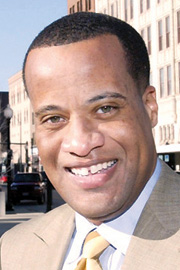
Youngstown Mayor Jay Williams
Youngstown SteelHounds owner Herb Washington and Youngstown Mayor Jay Williams have each had their say publicly about the circumstances surrounding the minor league hockey team’s expulsion from the Central Hockey League. The expulsion has raised the possibility of the city-owned Chevrolet Centre being dark for 32 days between October and March.
And while it is obvious that there is no love lost between the mayor and the team owner, the cause of ensuring the financial stability and viability of the $45 million arena is far greater than the personal feelings of two individuals.
We urge Williams and Washington to bury the hatchet — no, not in each other’s back — and to find a way of giving the people of the Mahoning Valley a 2008-09 season of professional hockey. Although the mayor has said that a year’s break would not be the end of the world, and that he is confident of some of the 32 dates being filled with other events, there are practical reasons for having hockey.
First and foremost, the Chevrolet Centre was designed with hockey being the main anchor, and after several years becoming a profitable proposition for the team and the city.
Second, there is the issue of fan participation. After three seasons of the SteelHounds playing at the Chevy Centre, Mahoning Valley residents are just now beginning to be comfortable with a game that does not have deep roots in the area. A year’s break would result in the deterioration of the fan base.
Finally, there is the reputation of the Valley that must be taken into consideration. When former Congressman James A. Traficant Jr. of Poland, D-17th, secured a $26.8 million federal grant for what he called a convocation center — it was originally to be located adjacent to the campus of Youngstown State University — there were skeptics both locally and in Washington who predicted failure of such a project.
Unprofitable facilities
Indeed, this newspaper warned that such facilities do not turn a profit, which is why private investors refrain from owning them. Across the nation, sports and entertainment arenas similar to the Chevrolet Centre are financed by taxpayer dollars and owned by local governments.
When it became clear that former Mayor George M. McKelvey’s invitation to the private sector to “bring your checkbook” to the table in order to take advantage of the $26.8 million federal grant had fallen on deaf ears, we urged city officials to give serious thought to having the federal money reprogrammed so it could be used for downtown and neighborhood revitalization projects. Our idea was dismissed, and the arena project was pursued.
So today, not only has the centre failed to consistently turn a profit, but the future of professional hockey is up in the air, and city government is on the hook for $12 million that carries an annual repayment obligation of more than $1 million. In fact, the city has only been able to pay the yearly interest of $750,000 — out of its general fund. It borrowed the money for its share of the construction cost — even though residents were initially told there would be no general fund money in the project.
All of this points to the stark reality that the Chevrolet Centre cannot afford to lose professional hockey as a tenant.
We, therefore, reiterate the suggestion we put forth last Sunday: Mayor Williams should host a meeting of all individuals involved in hockey so a game plan can be developed that would fill the 32 days reserved for the SteelHounds.