 43
43

HOBBIES FEEL THE PINCH
 Photo
Photo
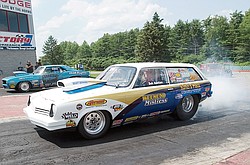
7.5.2008 Bob Bastian, of Warren, pulls up to the starting line at Quaker City Drag Strip in his 1975 Vegas Station Wagon, a Super Pro Class dragster, with a personal best record of an 8.39 second quarter mile at 163 mph. Bastian fixed and assembled the car, which he has been racing for 10 years, with the help of Abruzzi Transmissions, of Warren, and Koffel's Place who does the engine work. Bastian has racing since 1964 primarily dragsters since 1964 with a brief stint of stock car racing. Bastian and his daughter describe the community at the Quaker City Drag Strip as "one big family" where "the kids have grown up together on the weekends" and people gather not only on the track but also off the track in one case taking a trip to Six Flags. "I've thought about giving it up every weekend I lose," says Bastian referring to his interest in drag racing, " but 10 minutes later I'm ready to go again." "I've lived on adrenaline all my life," says Bastian, who spent 31 years as a firefighter, and considers adrenaline and competition as major appeals of drag racing. "Me and my daughter are competitive together," says Bastian, " and she'll be a good racer when she gets in a big car."
 Photo
Photo
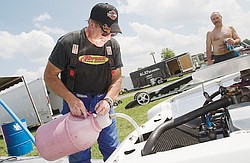
[7.5.2008] Bob Bastian, of Warren, fills the fuel cell on his 1975 Vegas Station Wagon, a Super Pro Class dragster, at Quaker City Drag Strip July 5, 2008. Bastian fixed and assembled the car, which he has been racing for 10 years, with the help of Abruzzi Transmissions, of Warren, and Koffel's Place who does the engine work. Bastian has racing since 1964 primarily dragsters since 1964 with a brief stint of stock car racing. Bastian and his daughter describe the community at the Quaker City Drag Strip as "one big family" where "the kids have grown up together on the weekends" and people gather not only on the track but also off the track in one case taking a trip to Six Flags. "I've thought about giving it up every weekend I lose," says Bastian referring to his interest in drag racing, " but 10 minutes later I'm ready to go again." "I've lived on adrenaline all my life," says Bastian, who spent 31 years as a firefighter, and considers adrenaline and competition as major appeals of drag racing. "Me and my daughter are competitive together," says Bastian, " and she'll be a good racer when she gets in a big car."
By HOLLY SCHOENSTEIN
Economic decline leaves less money for fun activities
YOUNGSTOWN — Whether hobbyists prefer drag racing, boating or golf, they have one thing in common — battered wallets.
And to ease the overall financial burdens caused by expensive gasoline and a slow economy, some people have been giving their favorite hobbies less attention.
More expensive hobbies, including racing, boating and golfing, seem to have been affected the most.
But even dwindling expendable income hasn’t scared away Warren resident Bob Bastian, who has been drag racing since 1964.
“Racing is not a hobby, it’s a disease,” Bastian said. “Drag racing gets your adrenaline flowing. It’s competition; you’re trying to be the best and beat the best.”
His adrenaline was flowing when he worked as a firefighter on the east side of Cleveland, but since retiring in 2004, drag racing is his fix.
Bastian used to travel to North Carolina and Florida to race a dragster, but the upward spiral of fuel prices has caused him to scale back. Now he races his 1975 station wagon at tracks closer to home.
He also looks for other ways to save money while participating in his beloved hobby, such as paying $250 a year to park the station wagon and trailer at Quaker City Raceway in Salem so he doesn’t have to tow it back and forth.
“If I had to tow my trailer every weekend, it would cut me down to racing about three weeks a month,” Bastian said.
But even the most dedicated drag racers are still racing, there has been a drop in the number of racers at some strips.
Dan Swindell, president of Quaker City Raceway Inc., has recorded a decline of one-third in the number of drag racers who have registered for competitions this summer.
“You can’t [drag race] anymore with a $100 bill,” Swindell said. “It’s really bad. This is by far the worst we have seen in ten years.”
More racers are looking for payouts and more have been entering competitions that pay than those that don’t give prizes, he said.
Despite the decline in registrations, spectatorship has held steady, if it hasn’t increased slightly, he said.
Warren resident Marco Abruzzi, a two-time world drag racing champion at the top amateur level for the Norwalk-based International Hot Rod Association, enters about 30 paying competitions each year.
But now he considers several factors to determine whether entering specific competitions are worth it.
“I have been selecting ... [tracks] with two or multiple races in a weekend,” Abruzzi said.
When deciding whether to register for a race, he considers the cost of the entry fee, the amount of the prize, the distance to the strip and whether he must take time off work.
He also has changed the way he gets to the races.
“I’ve been driving the speed limit in my motor home to make sure I get the most gas mileage,” he said.
Meanwhile, some drag strip owners have had to change how their tracks operate to account for the decrease in revenue. Swindell has leased out Quaker City for special events.
“We’re trying to make up for the deficit of racers,” Swindell said. “A lot of areas have scaled back. ... I think everyone is in a mode to survive.”
He has been considering adjusting routine maintenance at the strip, such as the number of times the grass is cut.
About 10 percent fewer drag racers have been entering competitions nationwide, according to Mike Perry, director of communications and public relations for the IHRA.
Although no official records have been kept regarding the popularity of drag racing in the U.S., Perry said its glory days were in the ’60s and ’70s.
“The fan base, even though it may not be what it was back then, it is still very passionate,” he said. “Hard-core sportsman drag racers are racing somewhere every weekend. They just have to find things that make sense for them.”
Circle-track racing has not been immune to the economy, either, and some have had to vamp up their marketing to attract more patrons.
Kate Blaney, a marketing representative for Sharon Speedway in Hartford, has mailed thousands of fliers with coupons to residents in the area. She said many circle-track racers are aging so Sharon Speedway is targeting younger fans.
“I’m hoping we’ll stay the same or get better,” Blaney said. “All racetracks in the country are fighting for fans. There’s so much more to do. We fight for our entertainment dollar more now. It used to be that there wasn’t as many things to do in a weekend, and that’s changed now.”
Sharon Speedway has also raised some prices at its concession stand.
The long arm of the economy has not bypassed the hobby of boating, either. “There are fewer boats on the lake and at our boat ramps,” said Barb Neill, Lake Milton State Park manager.
Before gas prices skyrocketed, the lake had “extremely high attendances,” she said. About 4,000 to 5,000 boaters have been coming to Lake Milton on Saturdays this summer, whereas 8,000 to 9,000 came a couple of years ago.
Unleaded fuel at a gas station at Lake Milton State Park has been selling for about $4.50 per gallon, but gas outside of the park can cost about 60 or 70 cents less.
More people have been participating in other activities near the lake, such as picnicking and sightseeing, Neill said.
“What I really see is the larger boat owners, who have the 35 or 40 foot boats, are going to continue to boat,” said Pam Taylor, a park ranger at Berlin Lake in Berlin Center. “The middle class person with a mom, dad, two kids and the small fishing boat is what the economy has hurt.”
Tom Petrilla, commander of the Mosquito Lake Power Squadron based in Cortland, has changed the way he boats with his 25-foot Monterey Sport Cruiser, which gets two miles to the gallon. In an attempt to get better gas mileage, Petrilla scheduled the boat for a tune-up, unloaded some unnecessary equipment to make it lighter, and has tried not to cruise fast.
“The faster you go, the more gas you’re going to use,” he said.
His boat is docked at the Ashtabula River, a half mile from Lake Erie. He has noticed that boaters are tending to spend more time on their boats while docked rather than taking them out.
“At the marina there are two dozen boats, and they become floating campers because people aren’t taking them on the water,” he said.
The tight economy has also taken some of the swing out of the hobby of golfing.
Mill Creek Metro Park Golf Course in Boardman, a public course funded by taxes, has recorded a 10 percent decline in sales this year compared to last year.
“The economy has definitely impacted us,” said Dennis Miller, golf director for Mill Creek.
He attributes the decline in sales to fewer golfers from outside Mahoning County playing at the course because of gas prices.
Otherwise, he said the course is a good value for golfers.
“Our rates are excellent; we haven’t raised the rates in 10 years,” he said. Mahoning County residents pay $27 for 18 holes with a golf cart, and non-residents pay $32.
“I don’t foresee in the near future, given the economic climate, that we’ll raise our prices,” Miller said. “We want to encourage more golf and promote the game.”
Jim Popa, executive director of The Ohio Golf Association, said golf is doing better this year than last overall, but there is still a decline from a couple of years ago.
But the economy has negatively impacted what Popa called the dynamics of golf.
“There are probably more casual golfers today, such as those who play once a month, whereas golfers played twice a week in the old days,” Popa said. “In the old days, a serious golf player played twice a week and once on a weekend. Golf is expensive to play and time-consuming. Seniors have the time and the money.”
He said seniors make up the majority of golfers, and they are playing well into their 80s. But golf celebrities, such as Tiger Woods, have attracted the attention of a whole new generation, which he feels might be “the salvation of golf.”
“Everybody has seen a decline in their numbers of golfers throughout the state,” Popa said.
The changing dynamics of golf, competition from other area courses, and the sometimes unpredictable weather, have challenged some courses in the area.
Public courses face different obstacles than private golf clubs, but they have decreasing sales in common. For public courses, sales of greens fees have been down and, for private clubs, membership sales have been down.
Some private clubs have been adjusting their initiation fees for new members and monthly dues to attract more members. Popa said 15 to 20 years ago, initiation fees at some private clubs were $20,000 to $25,000 with monthly fees of $300 to $400. Now clubs have been making deals by waiving initiation fees and charging $200 to $600 a month.
These special deals have been successful in attracting more members to private clubs, Popa said.
Old Avalon Golf Course, which is owned by the city of Warren, has also felt the pinch of the economy.
“We’re pretty much stuck at rock bottom,” said Barry Hernon, head golf professional at Old Avalon.
To combat decreasing sales, which have been down about 20 percent since this time last year for greens fees and concessions, the course has had to implement changes.
Greens fees, which are the course’s biggest money maker, were slashed about $6 earlier this month, Hernon said. Now, golfers can play nine holes for $10 and 18 holes for $20 with golf carts, on weekdays. On weekends, the greens fees are $15 for nine holes and $30 for 18 with carts.
“Some of that could be due to weather, some of it could be due to economy; we’re not really sure. We’re guessing economy, and that’s why we’re changing our rates,” Hernon said. “It’s a very aggressive price decrease, and I would expect our play to pick up and get back to normal.”
He does not believe the prices can go much lower, so if the discounts do not work, the course will be forced to cut other expenses.
hschoenstein@vindy.com