 43
43

Cruze to fuel GM Lordstown’s ongoing positive evolution
 Photo
Photo
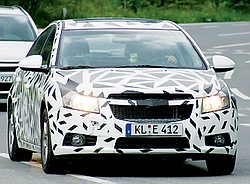
Spy photos of a camoflauged vehicle seen in Europe, believed to be the new Chevrolet Cruze.
Cruze to fuel GM Lordstown’s ongoing positive evolution
Announcement this week that the General Motors Corp. will build its new global subcompact car dubbed The Cruze at its Lordstown Complex highlights a four-decade-long evolution of progress for the Mahoning Valley plant.
In the short term, the news caps a series of incremental developments this year that will secure stability and growth for the Valley’s largest employer. In recent months, we’ve received news, piece by piece, of GM’s decision to award Lordstown a new car, of the phenomenal sales spurt of its current Cobalt model, of the addition of a third shift that will add 1,400 employees to the facility, and most recently, of the selection of the local factory to be the American manufacturer of the ultra fuel-efficient Cruze.
Filling the seemingly insatiable consumer appetite for the Cobalt and preparing for the launch of the Cruze usher in the biggest hiring spurt at the Lordstown facility since it opened in 1966.
On a broader plain, the Cruze news proves that the Valley auto production center has reached a new plateau in its 42-year history of making vehicles with increasing quality and consumer appeal.
Some early challenges
Following the plant’s initial success in producing 453,000 Chevrolet Impalas, Caprices and Bel Airs in its first years of operation came the much maligned Vega, which dominated production through the 1970s. The Vega’s propensity to rust and its reputation for poor engine reliability made it the butt of many jokes and downward sales.
From 1982 to 2004, the Cavalier and its sister Sunbird/Sunfire became the mainstay of the plant. Although the Cavalier improved consistently in styling and performance over its long life, it still failed to win domination over the increasingly competitive and global small-car market. Today, even a Cavalier enthusiasts club that is active nationwide celebrates what some see as the intrinsic mediocrity of the vehicle.
Flash forward to 2004 and the launch of the Cobalt. Mediocre it most definitely is not. From the onset of its production, it has captured an increasingly large share of its niche market and today ranks as GM’s best-selling vehicle for its size, performance, styling and, of course, high fuel-efficiency.
The launch of the Cruze builds upon those successes. “The Cruze is an evolution of the Cobalt,” said Stephanie Brinley, analyst for the Auto Pacific group in Southfield, Mich. The Cruze will mimic the size of the Cobalt but will be more competitive for its better use of interior space and its ratcheted-up fuel efficiency — about 40 mpg.
The new model will also position Lordstown to emerge as a major capital of GM’s global strategy. The vehicle will be marketed throughout the world, and all of the corporation’s small cars will adopt the Cruze nameplate.
Labor relations evolution
Just as the products at GM Lordstown have evolved positively over the past four decades, so, too, has its work force. Old-timers who recall the days of the Vega will also recall the plant’s image as a hotbed for militant unionism. That image has changed dramatically. The lack of labor strife at the plant in recent decades and the increasingly cooperative and constructive union-management relationship have brought many rewards, including a $1 billion retooling of the plant.
The launch of the Cruze will likely further enhance the positive image-building of the Lordstown Complex. As we congratulate the workers and managers for their stream of success stories, we also eagerly await the ongoing evolution of the plant. In it, we look for Cruze to fuel one of the most productive eras for the plant, its employees and the overall economic vitality of the Mahoning Valley.