 43
43

JUSTIFYING EMINENT DOMAIN
 Photo
Photo
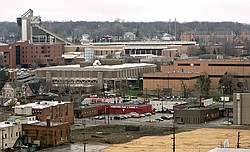
SPRAWLING CAMPUS: In conjunction with the new $34.3 million Youngstown State University business school to be built on the vacant land in the foreground, the city seeks to seize and demolish the small brown brick machine shop at 128 W. Rayen Ave., which has a brown garage door, for a proposed Hazel Street extension, which would curve around the Diocese of Youngstown office at bottom left.
Grenga
 Video
Video
Magistrate to decide fate of city machine shop
A YSU trustee says extending Hazel Street is unnecessary.
YOUNGSTOWN — The city’s attempt to seize and demolish a machine shop under eminent domain for a proposed street extension near Youngstown State University is on the fast track for a magistrate’s decision.
The city seeks to take the Grenga Machine and Welding Co. machine shop and storage facility at 128 W. Rayen Ave. so it can extend Hazel Street in conjunction with YSU’s new $34.3 million business school. The university broke ground for the new business school this fall.
Magistrate Dennis Sarisky of Mahoning County Common Pleas Court visited and inspected the vicinity of the machine shop immediately after a Wednesday court hearing in the case.
Sarisky said he expects to decide the case early next week. The magistrate invited shop owner Joseph Grenga, who is representing himself, and lawyers for the city to submit to him by 4 p.m. Friday proposed texts of the ruling they think he should make.
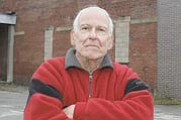
In a Vindy.com video interview, Grenga said he would like to build a two-story building for his company’s offices at the Rayen Avenue location and incorporate the current structure into it if he is allowed to keep the property. If he has excess space, he said he might rent it out.
“We need room,” Grenga said, adding that the shortage of space is “choking us to the point it’s hurting our business.” Grenga said he has lost business because the uncertainty over the status of the Rayen Avenue building has made it impossible for him to commit to a four- or five-month project.
Grenga has a prominent and influential ally in his battle to keep his property.
YSU trustee and former state Sen. Harry Meshel of Youngstown, who was seated on a visitor bench in the courtroom, said after court that the street extension is unnecessary and undesirable.
“I’ve always opposed the indiscriminate use of eminent domain,” Meshel said.
“They don’t need more traffic going into the Youngstown State campus. They don’t have room for more traffic to go into Lincoln Avenue,” he said.
“The use of eminent domain historically in this country has been that there has to be an overwhelming public purpose to be served,” Meshel observed.
The U.S. Supreme Court has, in recent years, greatly broadened the authority of local governments to take private property by eminent domain. In its June 2005 Kelo vs. New London decision, the high court upheld eminent domain as an economic development tool.
In that case, the top court ruled 5-4 that a city may seize even nonblighted private property for a private economic development project, which officials think might benefit the public.
When the city filed its petition to appropriate Grenga’s property in January, it deposited $205,000 in escrow with the court and attached a city council resolution and ordinance in support of the acquisition.
Grenga rejected the city’s offer to buy the 102-year-old, 10,515-square-foot building for that amount.
Grenga purchased the building for $95,800 in 2001.
If the city acquires Grenga’s property, Grenga has a right to a jury trial to determine how much the city should pay him for it.
Anthony Coyne, a lawyer for the city, urged Sarisky to issue a writ of possession to the city.
“This section of Youngstown is part of an improvement project consistent with the Youngstown comprehensive plan,” and YSU’s Centennial Master Plan, Coyne said.
The city’s attempt to seize the property is part of a community development plan spelled out in a March 2008 memorandum of understanding signed by officials of the city, YSU and the Diocese of Youngstown.
The plan’s stated goals are to remove blighted or underused property in the Lincoln-Rayen-Wood Urban Renewal Area, relocate nonretail commercial uses and extend Hazel Street to the northeast to link YSU with the city’s downtown.
The plan calls for the northward extension of Hazel Street beyond its current terminus at Wood Street, so it would curve eastward around the Diocesan headquarters building and toward the university campus.
Under the agreement, the city, the university and the diocese are to share the $487,500 in real estate acquisition costs for the project.
If the city decides not to extend Hazel Street, “the diocese and the university shall have the exclusive right, but not the obligation, to purchase the city parcels in such proportion as the diocese and the university shall agree,” the memorandum says.
Sarisky allowed the memorandum into evidence but only as it pertains to Grenga’s property.
“The project is ready to go, and it would be important that the city be allowed to proceed with installing the roadway improvements,” Coyne said.
Grenga, however, told the magistrate that the city has abused its discretion and failed to negotiate with him in good faith.
“I firmly believe the city has no intention of building that road,” Grenga said.
“They have not presented a plan. They have not proven the need for this road,” Grenga added.
SEE ALSO: What is eminent domain?
milliken@vindy.com