 43
43

MEMORIES OF PEARL HARBOR
Alfred Gaskell
 Video
Video
Pearl Harbor survivor Alfred Gaskell reflects on his experience in the war 67 years later.
By Jon Moffett
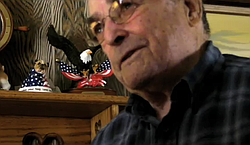
Alfred Gaskell sits in his Howland home surrounded by memories of his military past.
On the couch behind him are decorative throws with a naval theme and an American flag.
The walls of his front room display medals, banners and old photographs featuring him in his sailor’s uniform.
It was 67 years ago today that Japan attacked Pearl Harbor. But for Gaskell, the scene plays over again in his mind as if it had happened yesterday.
“It’s not easy to talk about,” Gaskell said as he wiped tears from his eyes. “I saw it from the beginning until it was all over with.”
Though his home, where he and his wife, LouRene, have lived since 1954, is thousands of miles from Hawaii and decades away from World War II, Gaskell recalls the morning of Dec. 7, 1941, vividly.
“Everybody was doing things they normally would,” he said.
He remember he was dressed in his “liberty whites” on the casual Sunday morning. Now 85, Gaskell was 18 at the time of the attack.
Gaskell was aboard the USS Curtiss, which was docked in the harbor during the attack. The Curtiss was a seaplane tender in the United States Navy and was commissioned in 1940.
Gaskell said he was in a parachute packing room aboard the ship before the attack. He and fellow sailors were waiting on a launch to take them ashore.
He recalled seeing the planes and hearing faint booms but “didn’t think anything of it” at the time.
“Very shortly after that, they called for general quarters, and we never call for general quarters in the port,” Gaskell said, noting it was reserved “for at sea and for drills.”
General quarters, Gaskell said, is the order for sailors to man their battle stations.
“We went up to the battle stations, and I was on the boat deck,” he said.
The Curtiss had two 5-inch guns, Gaskell said. One of the guns was destroyed when a Japanese plane crashed into it. Gaskell said he remembered seeing a dog in the cockpit with the pilot.
He added the planes were flying so low “you could knock the airplanes down just by sticking a broomstick up” in the air.
The Curtiss was stationed off Ford Island, Gaskell said, and had a clear view of the USS Utah. The USS Arizona was on the opposite side of the island.
“Seeing the Utah roll over ... I’ll tell you, it was terrible to see,” Gaskell said. “These big ships roll right over and everybody is inside; there were a lot of people in these ships. It was heartbreaking.”
Gaskell said the attack began around 7:55 a.m. local time and lasted until about nine.
More than 350 Japanese planes attacked the base in two waves. The Japanese air assault included targeting the US naval fleet, Ford Island and Hickam Field air base.
“It seemed like it was never going to end,” Gaskell said. “It was just one right after the other. When the Arizona blew up ... we could see the whole thing go up. It was horrible, absolutely horrible.”
Robert Bishop, of Youngstown, was aboard the USS Tennessee during the attack. He was inside the ship’s gun control room and listened to the details of the attack over the radio.
“My memories of the attack are different from others,” Bishop said. “But it was a terrible day.”
Bishop said his position was one of the safest on the ship. He added that when general quarters were called, he was at his battle station “within 30 seconds.”
Bishop and Gaskell are members of the Pearl Harbor Survivors Association’s Youngstown chapter. Gaskell said when he joined the group in 1974, there were 26 members. The group currently has “five or six” left.
The group will have a ceremony todayat the log cabin near the courthouse in Warren.
With fewer survivors, Gaskell said patriotism is also beginning to fade.
“We’ve lost a lot of patriotism in this country,” Gaskell said. “When I got home the first time after Pearl Harbor, I’d walk down the street and everybody would grab you, and hug you, shake your hand and thank you ... it’s not like that today.”
Special ceremonies help remind people of the horrific events so the same mistakes aren’t made, Gaskell said.
The events of Sept. 11, 2001, bore similarities.
“This thing in New York should have never happened,” he said. “Someone was asleep at the switch there, too.”
Gaskell said he was in Colorado during the attack on Sept. 11 and watched on television as the second plane hit the South tower of the World Trade Center.
Despite a desire to show the islands to his wife, Gaskell has not been back to Hawaii since the attack. He said his friend makes an annual visit to the memorial site and will be making his 27th consecutive trip this year.
Today, thousands of people, including Pearl Harbor survivors, make a pilgrimage to Hawaii to remember and honor the attack. A memorial was built above the sunken Arizona, which still leaks oil into the harbor. More than 3,500 Americans were killed or injured during the attacks, including 1,177 of the Arizona’s crew.
“I just couldn’t go back and see that ship [Arizona],” he said with tears in his eyes. “I know a lot of guys go back; I just could not do it.”
jmoffett@vindy.com