 43
43

Shop chairman fears economy hasn’t hit bottom
 Video
Video
By Don Shilling
Lordstown is eliminating the midnight shift and shutting down for all of January.
LORDSTOWN — General Motors is cutting production at its Lordstown complex and laying off 890 more workers, but the slashing may not be finished.
The national economy is spiraling downward, which concerns a local union official.
“In my personal opinion, we haven’t hit bottom yet,” said Ben Strickland, shop chairman of United Auto Workers Local 1112.
A worsening economy means fewer people will be buying cars, and Strickland is worried that car sales will be down again when GM executives meet in January to set production levels.
“Who knows what could happen,” he said.
That’s if GM makes it to January. The automaker has said it doesn’t have the cash reserves to fund its operations past the end of December and is asking Congress for loans.
“Everybody here is worried about taking care of their bills and taking care of their families,” Strickland said.
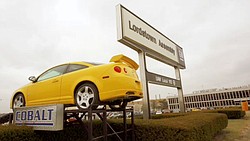
GM said Friday that the midnight shift at the Lordstown complex is being eliminated, and the assembly line will be shut down for all of January so dealers call sell off their inventories of Chevrolet Cobalts and Pontiac G5s.
Dealers are swamped with a 200-day supply, which is more than triple the number the industry likes to see.
Chris Lee, a GM spokesman, said the biggest factors dragging down sales are the tight credit market and low consumer confidence as large employers cut jobs by the thousands.
Erich Merkle, an auto analyst with Crowe Horwath in Grand Rapids, Mich., noted that automakers are advertising that they are arranging financing, but he said buyers must have “stellar credit scores” to be approved. That means many buyers haven’t been able to complete a sale, he said.
GM officials also have said they have lost sales because of talk of a bankruptcy. National surveys have indicated that most people will not buy a vehicle from an automaker in bankruptcy because they would be concerned about warranties and parts supplies if the company went under.
Falling gas prices also have trimmed the ranks of Cobalt buyers, Merkle said. Buyers are less concerned with fuel economy, although they remain leery about buying the biggest sport-utility vehicles, he said.
“Clearly, people are shifting back to the middle and away from the Cobalt,” he said.
The mix of low gas prices, a credit crisis and falling consumer confidence spells trouble for Lordstown. Cobalt sales dropped 54 percent in November, while GM’s overall sales fell 41 percent.
GM took steps Friday to align its production with that falling demand, announcing layoffs of 2,000 workers at three factories.
At Lordstown, the midnight shift is being eliminated, which will result in about 700 layoffs at the assembly plant and nearly 200 at the fabricating plant, which produces metal parts for the Cobalt and G5.
The shift was added in August because rising gas prices created a booming demand for the fuel-efficient cars. About 1,400 jobs were added, but some of them replaced 550 workers who accepted buyouts from GM and left July 1.
Of the 1,400 new jobs, about half went to new hires. About 400 were filled by transfers from Delphi Corp. and other GM plants, and 300 were filled by temporary workers.
Friday’s layoffs come on top of 1,060 layoffs that were announced last month. GM said then that it was going to slow down the speed of the assembly line, so daily car production could be cut from 1,500 to 1,110. With just two shifts, the daily production will be 750.
With nearly 2,000 hourly workers being laid off, staffing at the complex will be cut to about 2,300.
Those workers won’t return from the Christmas break until Feb. 2. GM previously had canceled production during the first two weeks of the month but on Friday added two more weeks of downtime.
During the downtime, workers are placed on layoff and are entitled to state unemployment compensation and supplemental benefits from the company, both of which add up to 85 percent of their pay.
Workers who are placed on indefinite layoffs because of the cutbacks receive the same benefits, except that new hires are eligible for supplemental benefits only if they have been with the company for a year.
When layoff benefits expire, workers with at least one year seniority traditionally have been placed in the jobs bank, where they receive nearly full pay even though they aren’t working. UAW leaders announced this week, however, that they intend to suspend the jobs bank as part of the Detroit automakers’ attempt to obtain federal aid. No details have been announced.
GM said the indefinite layoffs would be made by seniority but didn’t announce how much seniority was needed to avoid being cut. Workers said that people hired after 1995 were being laid off.
Transfers from Delphi, as well as the new hires and temporary workers, would be among the first to be laid off. For layoff purposes, the seniority of Delphi workers was set by the day they started at Lordstown.
Through union negotiations, the seniority date for GM transfers was set at Jan. 7, 1985, unless they started with the company after that date.
GM also said it was laying off 390 workers at its plant in Orion Township, Mich., where about 600 layoffs had been previously announced. It also is eliminating the midnight shift at that plant, which produces the Chevrolet Malibu and Pontiac G6.
GM is also cutting 700 jobs and eliminating a shift at a plant in Oshawa, Canada. About 500 other layoffs were previously announced at the plant, which makes the Chevrolet Impala.
shilling@vindy.com
SEE ALSO: Reality hits home and Congress, White House consider $15B in loans for auto industry.