 43
43

Pupils reflect on reason for Advent
 Photo
Photo
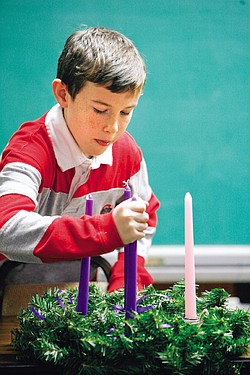
Mathew Weingart puts in the advent candles into his wreath as he puts the finishing touches on his advent wreath at St Paul Church in Salem
Fifth-graders at St. Paul School discuss the meaning behind the Christian season of Advent.
SALEM — Dave Markovich, sacristan at St. Paul Church, asked fifth-graders of St. Paul School to keep “prayer, penance and preparation” in their hearts during the Advent season.
Markovich, along with Patricia Bauman, school principal, and David Pancurak, fifth-grade teacher, led 18 pupils in an Advent retreat Monday. The event focused on learning the meaning of Advent and making an Advent wreath.
Advent began last weekend — on the fourth Sunday before Dec. 25 — and will end Christmas Eve. The 31‚Ñ2 weeks of reflection and anticipation lead up to Christmas Day, the celebration of the birth of Jesus. In the Eastern Orthodox tradition, Advent began Nov. 15 and is known as the Nativity Fast.
Pancurak said the aim of the retreat was to help pupils “understand the meaning of Advent and its traditions” while downplaying the gift-giving and commercial aspects.
As his pupils cut out prayers on sheets of paper for the four weeks of Advent, then pasted the papers on one pink and three purple sheets to make prayer booklets, Pancurak quizzed them on facts about Advent. To their teacher’s questions, the pupils answered that:
UThe first Sunday of Advent is the beginning of the liturgical year in the Catholic tradition.
UAdvent begins on the Sunday nearest Nov. 30, the Feast of St. Andrew, and ends on Dec. 24, Christmas Eve.
UThe word Advent (adventus) means coming.
UFour candles on the Advent wreath signify 4,000 years. Each week of Advent represents 1,000 years — from the time of Adam and Eve to the birth of Christ.
UThree purple candles are used, reminding man to be sorrowful for his sins. The pink candle, which is lighted the third week of Advent, signifies the hope and joy in Jesus, who is often called “light of the world.”
UThe wreath itself is a circle, representing God’s everlasting love.
UAdvent is the season to remember how the word of God became human in the birth of Jesus in Bethlehem.
Pancurak told his students that the season is one of “a change of heart,” as we should become more open to God’s love in our lives.
Pancurak also discussed the idea of how the increasing light of the candles, beginning with one the first week, then lighting others in successive weeks, represents how Christ’s presence brightens our lives.
Paige Johnson, 11, said this was her first time making an Advent wreath as she arranged the artificial boughs of the wreath. “It will be nice to have a ceremony at home on Sundays,” she said. She said she liked the idea of the wreath as a circle that is never-ending.
Paige said the wreath would help remind her about “preparation for Jesus’ birth.”
Ten-year-old Sidney Dailey said she appreciated the Advent wreath as a “symbol of the coming of Christ.” In fact, she has a wreath in her room, and her family has another.
Thomas Barfield, 12, concentrated on tying three purple and one pink ribbon on the candleholders in the wreath. Bauman suggested adding a touch of glue to hold the silky ribbon in place while tying it into a bow.
Thomas said this was the first time he put together an Advent wreath. “It will help me think about Jesus and his coming,” he said. He said he was looking forward to lighting the candles with his family.
Though the hands-on project engaged the young people, the adults said the activity also was meant to motivate their thoughts on the season.
Markovich said among his duties as sacristan are readying the church for services and decorating it for the season. He said Advent is a time to pray, reflect and meditate about the coming of Jesus. Penance is about being sorry for our sins, and preparation is looking forward to the birth of Jesus.
Bauman said she hoped the Advent retreat reinforced the idea of keeping customs. “It’s important that the young people carry on faith traditions,” she said.
She said school activities tie in acts of charity that Jesus performed and promoted to his followers.
St. Paul School has preschool through sixth grade.
Bauman said among activities were a schoolwide project of gathering nonperishable foods for the parish pantry, the fifth-graders collecting aluminum cans for cash to donate to Habitat for Humanity and sixth-graders participating in a Heifer Project to help buy an animal for a Third World village. Younger pupils make cards for shut-ins.
“Jesus was here to serve and take his place in the world,” Bauman said, noting that the service projects help teach pupils to follow that example.