 43
43

Residents get help with drug costs
 Photo
Photo
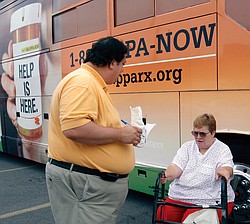
HELP IS HERE: Youngstown-area residents turned for help with their prescription medicine costs to the Help is Here Express, which was at the Youngstown Community Health Center on Wick Avenue. Trained specialist Thomas Townsend gathered information on Mary Murphy, who requires medication as the result of an auto accident several years ago.
The program helps struggling people get prescription medicines.
YOUNGSTOWN — When Mary Murphy’s ex-husband died in July, her Social Security check increased from $650 a month to $1,129 a month, making her ineligible for Medicaid and leaving her wondering how she was going to pay $800 to $900 a month in prescription medicine bills.
“I need help,” said Murphy, who was among a number of Youngstown-area residents who visited the Help is Here Express at the Youngstown Community Health Center on Wick Avenue on Wednesday afternoon. Forty people had visited the Help is Here Express during its visit Wednesday morning at the Warren Health Department.
Help is Here Express is a large orange bus, sponsored by the Partnership for Prescription Assistance, that tours the country helping uninsured and financially struggling people get free or nearly free prescription medicines.
“Before, I had Medicare and Medicaid. But, when my ex-husband died, the government forced me to take his check, which is enough more than mine, to make me ineligible for Medicaid as of Sunday,” said Murphy, who is unable to work and gets around with the help of a walker.
“All the government says is, ‘I’m sorry.’ But how can I pay that much for medicine and still have money for food and rent? I hope to get help here,” she said.
Daniel Allshouse and Sally Bendetta of Austintown, who suffer from hydrocephalus and epilepsy, respectively, visited the bus trying to lower what they pay for medicines.
Allshouse said he pays $151 a month for his medications, and Bendetta pays $31.99 a month.
“Everything is going up. If you can get your medicines for a cheaper rate, go for it,” she said.
Bettye Croft of Youngstown, a retired nurse’s aide who worked at the former Southside Hospital, said her insurance pays for half of her medications, but she is looking for help for the other half.
The bus tour is part of the Partnership for Prescription Assistance, a nationwide effort sponsored by America’s pharmaceutical research companies, which is raising awareness of patient assistance programs.
Bus personnel take information from people to help determine programs for which they might be eligible, and then help them fill out the appropriate application forms. It is then up to the patient to mail in the forms, which most often require a doctor’s signature and a valid prescription, said Jennifer Page, PPA spokeswoman.
People who visit the Help is Here Express often thank PPA personnel for letting them know help is available. Many times they don’t know where to turn, how to access the information on the Internet or where to call, she said.
To date, the PPA has helped more than 5 million patients nationwide, including more than 250,000 people in Ohio. Since its launch in April 2005, the PPA bus tour has visited all 50 states and more than 2,000 cities to educate people about patient assistance programs. The “Help is Here Express” is staffed by trained specialists able to quickly help uninsured patients in need access information on more than 475 patient assistance programs, including nearly 200 programs offered by pharmaceutical companies. When the “Help is Here Express” moves on, patients can visit PPA’s easy-to-use Web site (www.pparx.org) or call the toll-free phone number (1-888-4PPA-NOW) where trained operators field calls in 150 languages.
On a national level, the Partnership for Prescription Assistance is represented by Emmy-winning syndicated television talk-show host Montel Williams, named PPA’s national spokesman in January 2006. In addition, nationally recognized Telemundo talk-show host and author Mayte Prida leads the PPA’s Hispanic outreach effort.
Some 2,500 different brand-name and generic prescription medicines are available through participating patient assistance programs. In addition, the PPA provides information on nearly 10,000 free health-care clinics and has connected more than 241,000 patients with clinics and health-care providers in their communities, Page said.
To find out if there are patient assistance programs that may meet their needs, patients should call toll-free (888) 477-2669 to speak with a trained specialist or visit www.pparx.org.
alcorn@vindy.com