 43
43

Olympic workout: tai chi
Tai Chi in Wick Park
 Gallery
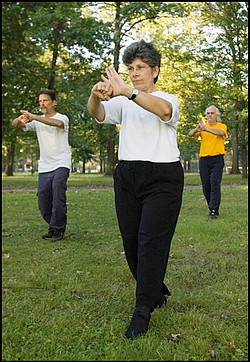
7.31.2008 Residents of the North Side led by Marie Lew practice Tai Chi in Wick Park.
The martial art brings a healthy balance to the lives of a North Side group.
By RICHARD L. BOCCIA
VINDICATOR STAFF WRITER
YOUNGSTOWN — Televised coverage of the Summer Olympics in Beijing during the next two weeks will likely include early-morning footage of Chinese tai chi groups practicing on the street.
This view of China’s culture, however, will be nothing new to a local group that practices the exercise and martial art.
For them, tai chi is more than regular exercise — the Chinese philosophy is part of their daily lives.
After studying tai chi for 35 years, Marie Lew of the North Side finds a good fit between the Eastern concepts of energy and flow and her work in Western health care.
She’s a licensed lymphedema therapist, treating the buildup of lymph fluid that causes swelling in the limbs. Normally, fluid in the body has a natural flow. Lymphedema results when that flow stops, and Lew works to reroute it.
“If you can’t go a certain way because the road has been removed, you have to go another way. You find an open pathway,” she said.
As in tai chi, you go with the flow.
“Historically, people practicing tai chi talk about energy flowing,” Lew said. That’s what health is; to have appropriate flow.”
In the East, she said, people see a balance of energy.
Lew says that some use tai chi to develop strength, while others want to become more active. By learning to use breathing and movement in coordination, students of tai chi tune their bodies like an instrument. Again, the goal is to find a balanced point, like the perfect amount of tension in a guitar string.
“If it’s too tight, the string will pop. Too loose, and you don’t get any music at all,” Lew said.
Lew sees health benefits in tai chi from a Western perspective, too. Practicing the art can develop stability in the legs of elderly, which can help them avoid falling. The breathing exercise massages the organs.
Since first practicing tai chi in 1973 when she was student of Mandarin language and Chinese literary classics, Lew has seen American interest in Chinese culture expand.
“Nowadays, Chinese martial art [is] so much more out there,” Lew said, pointing to cultural icons such as Bruce Lee and Jackie Chan who became the face of Eastern martial arts to Americans.
The other students who study tai chi with Lew are all from the North Side. They get together in a small, informal weekly practice session in Wick Park.
Eddie Hallahan, 59, has found that after studying tai chi, he’s more in control emotionally in his everyday life. He’s more aware of a boundary around him that others can’t disturb.
“It’s a tool for finding one’s center,” Hallahan said.
And while it can be a community exercise, it’s also highly individual. As they go through the same set of movements, each takes a slightly different approach, and small variations occur.
“In the process of learning it, you become it. What my body and spirit needs might be different than somebody else,” he said.
Evaline Abram-Diroll, 53, also practices tai chi at home, finding both solo and group practice enjoyable.
“Being in the group energizes the set,” she said.
She and the others slide from one pose to another, making and deflecting strikes from hypothetical enemies.
Eddie Istnick Jr., 55, practices tai chi for health and longevity. A former student of kung fu, Isthnick said he reached a point where the risk of injury from fighting was no longer worth it. Still, he’s drawn to the form of an exercise such as tai chi, and finds it interesting that a martial art has transformed into a healing art.
The discipline of waiting, of inaction rather than constant movement, also attracts him.
“In America, we’re gripping the steering wheel to get ahead,” he said, but there are times in tai chi when you simply stand and practice patience.
The group said Lew always shows them something new, but the traditions of tai chi span back through the centuries.
“You’re part of a continuing tradition, and I love that,” Abram-Diroll said.
That continuity is something missing from our Western society, Isthnick added.
While other martial arts may throw fighters at each other head on, Lew and the others see a disadvantage in that approach. Lew likens it to two bulldozers ramming head on — the bigger one always wins. Tai chi redirects incoming energy rather than just absorbing the blow, she said.
rboccia@vindy.com