 43
43

Judge reverses himself on recusal
 Photo
Photo
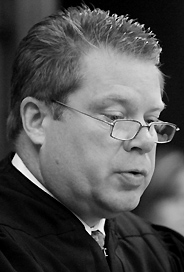
Judge John Durkin listens to testimony - Terrance Tate, whose confession was suppressed by the 7th District Court of Appeals, 8:30 a.m. The prosecution is appealing the suppression to the Ohio Supreme Court. Tate faces the death penalty.
By Ed Runyan
None of the lawyers or officials involved could be reached to comment.
YOUNGSTOWN — Judge John M. Durkin of Mahoning County Common Pleas Court has reversed himself on whether to step aside on a death-penalty murder case and allow the case to be reassigned to another judge.
Judge Durkin, during a hearing Monday in court, said he would overrule the county prosecutor’s office’s request for him to remove himself from the murder case against Terrence Tate.
But on Tuesday, his office filed a one-sentence judgment entry, dated Monday, saying that Judge Durkin’s court “hereby recuses itself and requests that this matter be reassigned” to another judge.
Judge Durkin was unavailable to comment on the judgment entry, and calls to attorneys handling the case for the prosecutor’s office and defense attorneys were unsuccessful late Thursday afternoon.
Prosecutor Paul Gains declined to comment.
Calls after hours to Atty. John Yuhasz, one of Tate’s defense lawyers, went unanswered.
A call to the law office of Atty. Lynn Maro, another of Tate’s lawyers, was answered by a person who said that he would leave a message for Maro to call back but that she probably would not because she had been ordered not to talk about the issue.
Judge Durkin gave a lengthy explanation in court Monday as to why he disagreed with reasons given by the prosecutor’s office for him to step aside.
The reasons pertain to two recently discovered letters Tate wrote to Judge Durkin that prosecutors said never made it to them.
Dawn Cantalamessa, an assistant county prosecutor, said her office didn’t get copies of letters Tate, 23, of Hilton Avenue, wrote to the judge in May 2006 and August 2007. One of them said Tate gave police false information about the death of 12-month-old Javonte Covington in April 2006 to keep the boy’s mother, April Ford, from going to jail.
In a phone call to his mother that prosecutors obtained recently, Tate said he took the blame for the child’s injuries because he believed he was facing only an assault charge and didn’t know the boy had died from his injuries.
Juhasz and Maro received copies of the letter.
Cantalamessa said she believed the judge should step aside because issues related to the two letters could potentially force him to be a witness in the case in regards to the two letters.
On Monday, Judge Durkin said his office has a standard practice of sending such letters to the prosecution and defense, so he has not violated a legal canon that prevents a judge from having “ex parte” (meaning one-sided) communications with a party in a legal action.
He said other witnesses could be called to testify to any information needed regarding the letters.
Cantalamessa has said the letters could have been useful during preliminary phases of the case against Tate that already have taken place, as well as in the upcoming trial.
runyan@vindy.com