 43
43

Most in Mahoning Valley face bankruptcy after losing jobs
Harris Video
 Video
Video
By Ed Runyan
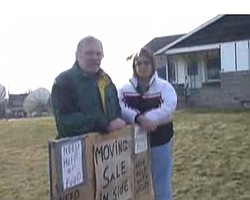
Paul Harris and his girlfriend, Tracy Cline, await the knock at the door, telling them it’s time to pack the last of their belongings and hit the road.
A year ago they became part of a trend that in 2008 is as American as apple pie and Mom: bank foreclosure.
Harris says he expects to be kicked out of his Howland Township home in May or June, when the house goes up for sheriff’s sale. “I just want to get out of this state,” Harris said, “but I don’t have the money to do it.”
The surprising thing is that foreclosure statistics from Mahoning and Trumbull counties show the crisis locally may have peaked in 2006.
Foreclosures filed in Mahoning County dropped 4.4 percent in 2007 compared with 2006 and 2.2 percent in Trumbull County. In the four years before that, they rose 35 percent in Mahoning County and 41 percent in Trumbull.
But ominously, foreclosure filings in January and February of this year are up 20 percent compared with 2007 in Mahoning County, 14 percent in Trumbull County.
Columbiana County, meanwhile, is at its highest point in five years. Foreclosures there were 530 in 2006 and 603 in 2007 — up 13.8 percent; they’ve been on the rise since 2004.
Ohio Treasurer Richard Cordray said the slight drop in foreclosures in Mahoning and Trumbull counties probably doesn’t indicate the problem here is going away. It may just be that the two counties experienced the crisis earlier than other counties, he said.
Baseball and foreclosures
He drew this analogy: Looking at Mahoning and Trumbull foreclosures in 2007 is a little like looking at the year after Major League Baseball slugger Barry Bonds hit 73 home runs in 2001. If his home run total had dropped to 69 in 2002, “you might say he’s trailing off,” Cordray said.
But because the numbers were so high — the number of homers Bonds hit in 2001 and the foreclosure numbers for Mahoning and Trumbull counties in 2006 — it’s hard to see a major shift, Cordray said. “You shouldn’t be misled by one-year numbers,” he said.
Harris and Cline may be examples of what a longtime real estate attorney considers a constant factor in foreclosure: job loss.
No matter how many other factors are at play — such as predatory lending and adjustable rate mortgages — it really comes down to job loss, said Tom Schubert, owner of the Schubert Title Agency in Warren and a former Trumbull County Family Court judge.
“Most people don’t want to lose their home. That’s the sacred asset,” he said. The reason most people experience foreclosure, he said, is, “They’re out of unemployment and out of a job.”
Schubert said he handled hundreds of foreclosures in Northeast Ohio from 1975 through 1992, and foreclosure numbers always rose in areas where plant closings and job losses occurred.
Harris, 54, found himself in that situation in November 2005, after working as a security guard 18 years at a local hotel, 14 of them as head of security. After new ownership took over, he said, his job lasted several more months. Finding another job has been fruitless, he said.
Tracy, 43, his live-in girlfriend for 21 years, has been unemployed about 18 months, ever since she lost her job cleaning office buildings because of an accusation of theft.
“I’ve been everywhere” looking for work, Cline said. Being without a telephone or having enough money for gas has hindered their chances, Harris said.
Family home since 1965
Harris inherited the home he shares with Tracy on Ridge Road in Howland after his parents died years ago. The house has been in the family since 1965.
With little assistance other than help with utilities, and no paychecks, the couple has relied on the help of friends and strangers. They have cut expenses and sold anything of value.
The couple has posted signs in the front yard with various messages. On one day, the signs said “Need help on food” and “We need parrot food.” Another day the signs said, “Foreclosure sale inside. Please help.”
Inside, there is little left to sell. They are down to one stuffed chair, a desk with computer and a few other items in the living room and kitchen.
The couple had as many as 40 birds at one time. They are down to two, and those will have to go eventually, Harris said: The birds won’t survive if he and Cline have to start living in their car.
No statistical data proves that job losses in the Mahoning Valley produced a foreclosure-friendly environment, despite lots of factory jobs disappearing here in recent years.
For example, figures provided by the Regional Chamber indicate joblessness in Mahoning, Trumbull, Columbiana and Mercer counties improved between 2003 and 2006 — dropping from 7.3 percent in 2003 to 6.3 percent in 2006. It remained 6.3 percent in 2007.
Many jobs lost in 2006
But good-paying jobs disappeared in large numbers in 2006, one of the worst years in local manufacturing and health care history.
Michelle Phillips, a research specialist with the Chamber, tracked job reductions at Delphi Packard, General Motors, WCI Steel and Forum Health in 2006. She found those four employers eliminated 5,000 jobs that year, most of them paying $19 to $30 an hour. She estimated an additional 3,500 jobs were lost as an indirect consequence of jobs lost at those four places.
There were still more layoffs in 2007, especially at Forum Health and Indalex, but not nearly as many as in 2006, Phillips noted. Such a glut of layoffs is bound to affect the local economy in some manner, but it’s impossible to say whether it has affected foreclosure numbers, she said.
In Columbiana County, Salem appears to be the hot spot for home foreclosures — but no one is sure why.
The county in 2003 had 484 civil foreclosures filed; in 2007, it had 603. Sgt. Kenneth D. Biacco Jr., who handles foreclosures for the county sheriff’s office, said 99 percent of all foreclosures are for homes.
“Years ago, we were never in Salem,” he said. Now, many homes in the city sport an orange sticker to indicate the property is in foreclosure. A lot of value is evaporating: A house in Salem had been valued at $103,000 but the sheriff’s mandatory appraisal put it at $85,000. Under state law, bidding must begin at two-thirds of the appraised value, or $56,000. It was purchased for $65,000.
Biacco said the foreclosure increase may stem from the loss in local manufacturing jobs in recent years, and variable rate mortgages.
But Audrey Null, executive director of the Salem Area Chamber of Commerce, sees other problems. She believes the local increase may stem from high-interest loans given to home buyers with limited income. Another problem may be overspending by people who want the big-screen TV and the SUV to go along with their new house.
Local credit counselors interviewed for this story say they are at a loss to give specific reasons why foreclosure rates rise and fall.
Statewide, Cordray has helped battle foreclosures by starting Save Our Home task forces in all 88 counties. The goal is to help homeowners avoid foreclosure by guiding them to credit counselors, telling them to talk to their lender and educating them on how foreclosure works.
From a statewide perspective, Cordray says the foreclosure crisis is not letting up, with 2007 foreclosures statewide rising 5 percent over 2006. The problem in states such as Florida and California, however, has exploded in recent months, attracting more attention to the problem at the national level.
In Ohio, the foreclosure crisis will likely remain for a couple more years, until the most problematic loans — subprime or adjustable rate mortgages — work their way through the system, Cordray said. It’s tough to tell whether Ohio has been through the worst of the crisis, he said.
Where to get help
Help is available. For example, Debra Bish, executive vice president at First Place Bank, said the bank has kept foreclosure rates low by encouraging dialogue between the bank and the customer as soon as a customer runs into problems with their house payment.
“We’re looking at foreclosure as a last result,” she said, adding that the bank has instructed its employees to help customers “stay in front of the problem” as much as possible.
Jamael Tito Brown, who heads the Save Our Homes Task Force for Mahoning County, says he thinks adjustable rate mortgages are the biggest reason why many current foreclosures are being filed. Such mortgages, which start out at a “teaser” rate and reset higher later, can cause someone to lose his home who has a stable income, Brown noted.
Also, low-income homeowners continue to fall victim to predatory lending practices. Cherie Howard, an attorney with Northeast Ohio Legal Services in Youngstown, said these practices generally involve promises of home improvements or debt consolidation, and may involve unrealistically high income statements and property appraisals. For example, Howard remembers one Youngstown house appraised at $105,000 that was actually worth $30,000.
In many cases, a salesman persuades a homeowner to sign papers for a home improvement loan that lines the pockets of a contractor, appraiser and title company but gives the homeowner little more than a huge loan payment.
If foreclosure numbers have dropped, Howard said, she would attribute it to Ohio Attorney General Marc Dann’s attempts to hold predatory lenders criminally and civilly responsible for their actions. Such action, along with greater awareness of predatory lending, may be helping, she said.
Danielle Lazor, program manager with Family Financial Education Services of Youngstown, said it seems like there are too many reasons for foreclosure to blame just one thing. She adds several other reasons to the list: financial problems brought on by illness, paying large amounts of money to help children and grandchildren, getting into debt with credit cards or cash advance companies and simply showing too little restraint in buying habits.
“Some people have a tremendous amount of wants versus needs, like the big car,” she said. In one example, a woman came to her because she was behind on her utility payments. At around the same time, the woman took out a 72-month loan for a Cadillac, something she obviously could not afford.
“They want it now,” she said.
In most cases she sees, the person losing his home to foreclosure is also behind on the utilities and deeply in debt to the credit card companies.
runyan@vindy.com