 43
43

VIDEO| Healing drum circle targets stress, depression
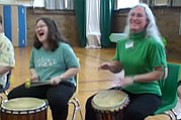
 Video
Video
Think you don’t have rhythm? You’ll find it at a drum circle.
VILLA MARIA, Pa. — Pat Evans-Morris jokingly calls the rhythm therapy of the healing drum circle “instant Prozac.”
The licensed mental health and chemical dependency counselor, plus certified yoga teacher and therapist, isn’t making light of medication or those who take it.
“I believe in Western medicine ... using medication or therapy or both ... whatever the person needs,” the Canfield woman said. But the phrase instantly communicates the benefit of the healing drum circle — it simply makes participants feel better.
This prescription positively alters one’s mood without chemicals and formal therapy.
About 20 people, men and women, recently gathered at Villa Maria Community Center, where a healing drum circle is held monthly.
“It’s a total release. You feel rejuvenated,” explained Linda Fahl of Youngstown. She has participated in smaller drum circles at the home of Evans-Morris, with whom she’s been friends for some 30 years.
“Pat makes it a lot of fun,” Fahl said. “It’s kind of like jumping rope ... you just know when to join in. You go with your internal rhythm.”
Evans-Morris projects a gentle touch and the right measure of encouragement and direction as she draws first-timers into drumming. She asked one participant to play a “heartbeat” rhythm, a steady beat around which others joined in. You might think this would result in chaos and just plain noise, but surprisingly, it doesn’t.
“Everyone adds a layer. It’s syncopated and sounds really great,” Evans-Morris said. “Each set of rhythms has a peak,” she said, “and then you might go off kilter ... so we give it a rest and start something new.”
She uses phrases such as “we are all one spirit” to define the beat, and then participants first clap the beat and then turn to their drums.
Evans-Morris provides many of the drums, but participants are invited to bring their own. Bongo, congas, tom-toms, an unusual drum filled with beads that makes an “ocean” sound and d’jembe, African drums, are among choices. “I’ve collected them over the years,” she said. “I let people choose, but sometimes I suggest a drum.”
Evans-Morris took drum circle lessons from Arthur Hull. The internationally known percussionist is regarded as the developer of the community drum circle. At a five-day workshop with Hull, Evans-Morris said she learned how to incorporate cultural rhythms into the drum circle and how to use “peripheral” hearing when leading or playing with the group.
“The big conical-shaped bass drums can act like a metronome,” she said. “They sculpt the sound.”
For those who would like to try drumming but think they have no rhythm, Evans-Morris points out the heartbeat. It’s your body’s natural rhythm, and that spontaneously surfaces when you participate in a healing drum circle.
Drumming, as a form of communication and expression, is practically as old as mankind itself. “It brings together cultures,” Evans-Morris said, noting that she uses some American Indian and African rhythms.
“The heartbeat of the group becomes syncopated and we come together as one,” Evans-Morris said. “That’s when we’re rocking. It’s a peak experience ... when we’re closer to a higher plain than ourselves and we feel as one with the group.”
People attend the drum circles for a variety of reasons, citing “they had a longing” ... “curiosity” ... or “were drug along by a friend.”
Eric Schaffert of Poland, who works in medical sales, said, “This is atypical of my work, where there is pressure.” He described the experience as “letting the inner child come out.”
No matter what the reason, the participants share a common, sometimes startling, experience. “Drumming gives you joy, lightens your mood, it’s good for stress management and depression,” Evans-Morris said. “And it’s a good anger management technique ... you direct those feelings elsewhere ... not yourself or someone else.
“I’ve seen people just start giggling and laughing,” Evans-Morris said.